Category: Updates

  • 3 Common Myths About Volunteering

    3 Common Myths About Volunteering

    Volunteering isn’t just about giving, it’s about growing, connecting, and making real impact. But there are still a few myths that hold people back. Let’s clear them up!  .png

    MYTH #1: “I don’t have time to volunteer.”

    ✅.pngTruth: Even just 1-2 hours a month can make a difference! Volunteering is flexible, there’s something for every schedule.

    MYTH #2: “I need special skills or experience.”

    ✅.png Truth: Passion and willingness to help are more important than experience. We’ll guide you every step of the way!

    MYTH #3: “Volunteering doesn’t really change anything.”

    ✅.png Truth: Every action counts. Whether you’re mentoring, organizing, or spreading awareness-you’re part of real, positive change.

     .pngReady to get involved? Join us in making a difference.

    #VolunteeringMatters#Prosdoma

  • Climate Change & Migration: The Urgent Need for Action

    Climate Change & Migration: The Urgent Need for Action

    Climate change is increasingly pushing millions of people out of their homes.  ️ As global temperatures rise, vulnerable communities are facing a growing crisis – the need to migrate in search of safety and better livelihoods.

    Here’s what you need to know:
      Climate Migration on the Rise: From droughts to floods, extreme weather events are making it harder for people to live where they once thrived. Nearly 26 million people were displaced due to climate change just last year alone. The situation is only going to worsen, with projections showing 216 million people displaced by 2050. 
      The Consequences: As people move from rural areas to urban centers, they face not only environmental challenges but also economic hardships. In regions like sub-Saharan Africa, where water stress and land degradation are major issues, climate change is having devastating effects on agriculture and livelihoods. 
      What’s Being Done: Governments, NGOs, and international bodies like IOM are working on planned relocation, where entire communities are moved in an organized way to safer regions. But more support is needed to help these vulnerable groups adapt.
      Prosdoma’s Role: At Prosdoma, we work to connect newcomers with vital resources, ensuring they can navigate the challenges posed by migration. By offering job assistance, legal aid, and sustainable development initiatives, we help build resilient communities that thrive in the face of climate adversity.
      Take Action: As the climate crisis accelerates, we must come together to support those displaced and work towards a sustainable future. Let’s make migration part of the solution, not the problem. 

    #ClimateChange #Migration #ClimateCrisis #Urbanization #SustainableDevelopment #Prosdoma #Adaptation #EnvironmentalJustice #ClimateMigration #CommunitySupport
    Source: https://www.globalissues.org/news/2024/11/20/38346
    AC

  • Post of the Day

    Post of the Day

    Can AI Revolutionize Agriculture Without Leaving Small Farmers Behind?

    As artificial intelligence (AI) reshapes nearly every industry, agriculture faces a pivotal moment. According to the CAST 2025 report, AI is unlocking game-changing opportunities in crop yield prediction, livestock monitoring, weed control, and even food safety—but also revealing a digital divide between large agribusinesses and smallholder farmers.

    The report highlights several key use cases:

    • ExtensionBot, a generative AI trained on 360,000+ agricultural documents, delivers precise, local farming advice.
    • See and Spray AI reduces herbicide use by targeting individual weeds with image recognition.
    • FRAIL-bots assist harvesters in the field, boosting productivity and reducing physical strain.
    • AI even helps detect counterfeit wine and enhance crop nutrition through microbiome data.

    Yet major challenges remain:

    • Data incompatibility, weak rural connectivity, and privacy concerns hinder adoption.
    • Many AI models fail to adapt across regions or crops.
    • Farmers fear losing both data ownership and traditional knowledge.
    • The rural workforce needs urgent AI training and inclusion.

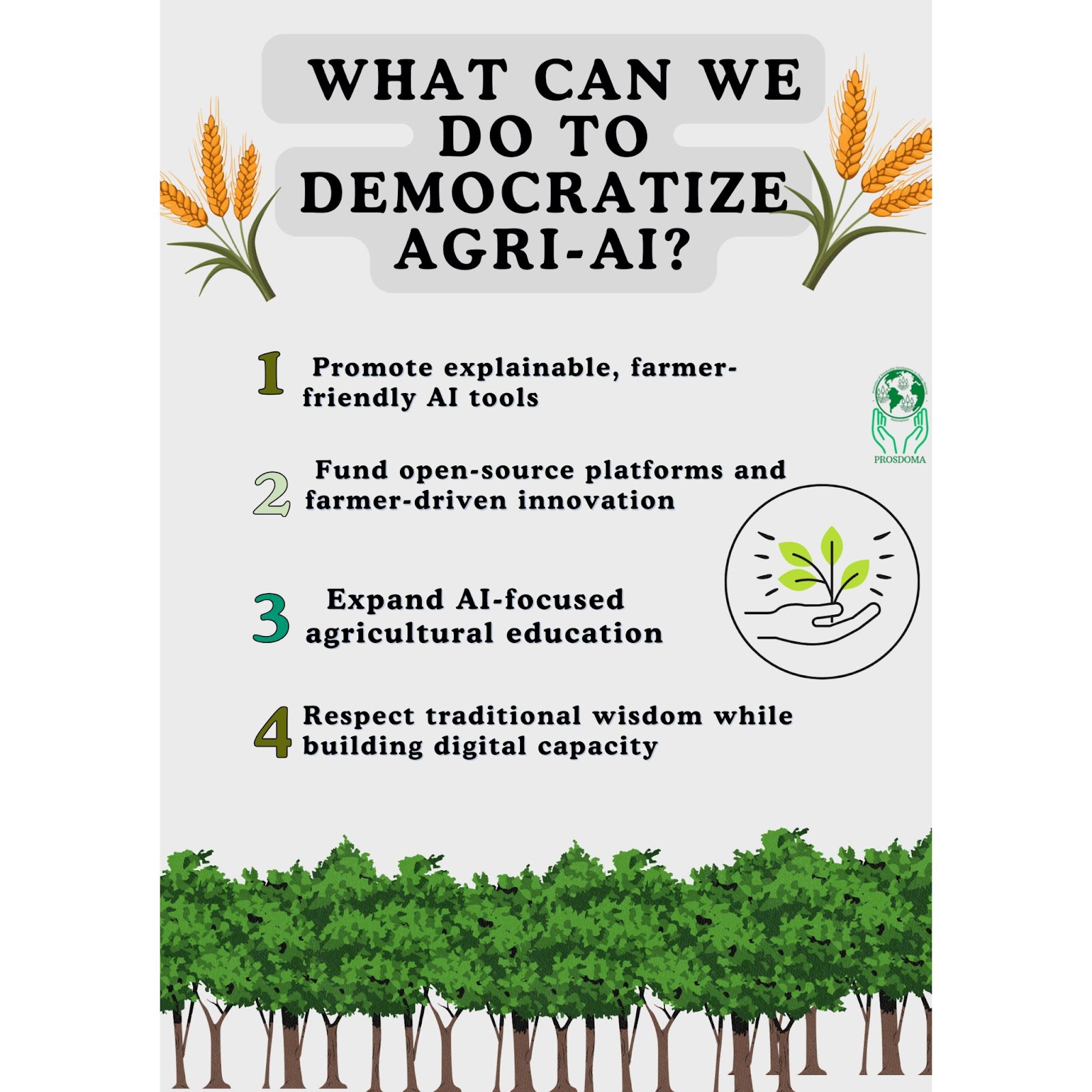
    What can we do to democratize agri-AI?

    1. Promote explainable, farmer-friendly AI tools
    2. Fund open-source platforms and farmer-driven innovation
    3. Expand AI-focused agricultural education
    4. Respect traditional wisdom while building digital capacity

    At PROSDOMA, we believe innovation must be inclusive. That’s why we support not just tech deployment, but community empowerment. From Sub-Saharan Africa to rural Canada, we’re committed to building a future where AI enhances dignity, knowledge, and food justice.

    Join Us: https://old.prosdoma.org/

    By E.D.

    Source:
    CAST. (2025). AI in Agriculture: Opportunities, Challenges, and Recommendations.

    #AgriTech #AIinAgriculture #SmartFarming #DigitalInclusion #FoodSecurity #PROSDOMA #ClimateSmartAgriculture #RuralEmpowerment #AIforGood #PrecisionFarming #SustainableInnovation

    #prosdoma 

    Can Sustainable Agriculture Transform Sub-Saharan Africa? A Closer Look at What Works—and What Doesn’t

    Agriculture sustains up to 90% of the rural population in Sub-Saharan Africa (SSA), yet smallholder farmers face compounding crises: climate variability, soil degradation, pest outbreaks, and food insecurity.

    A systematic review by Sithole & Olorunfemi (2024) highlights how Sustainable Agricultural Practices (SAPs)—like crop rotation, intercropping, water harvesting, mulching, and agroforestry—offer practical, science-backed solutions to increase resilience and productivity.

    Key findings:

    • SAPs significantly boost yields, soil health, and household income
    • Adoption is higher in East Africa (e.g., Ethiopia, Kenya) than in West and Southern Africa
    • Agroforestry, improved seed varieties, and water harvesting are among the most promising innovations

    But challenges persist:

    • Land tenure insecurity, lack of training, gender disparities
    • Weak rural advisory systems and limited access to finance
    • Farmers’ hesitation due to slow return on investment

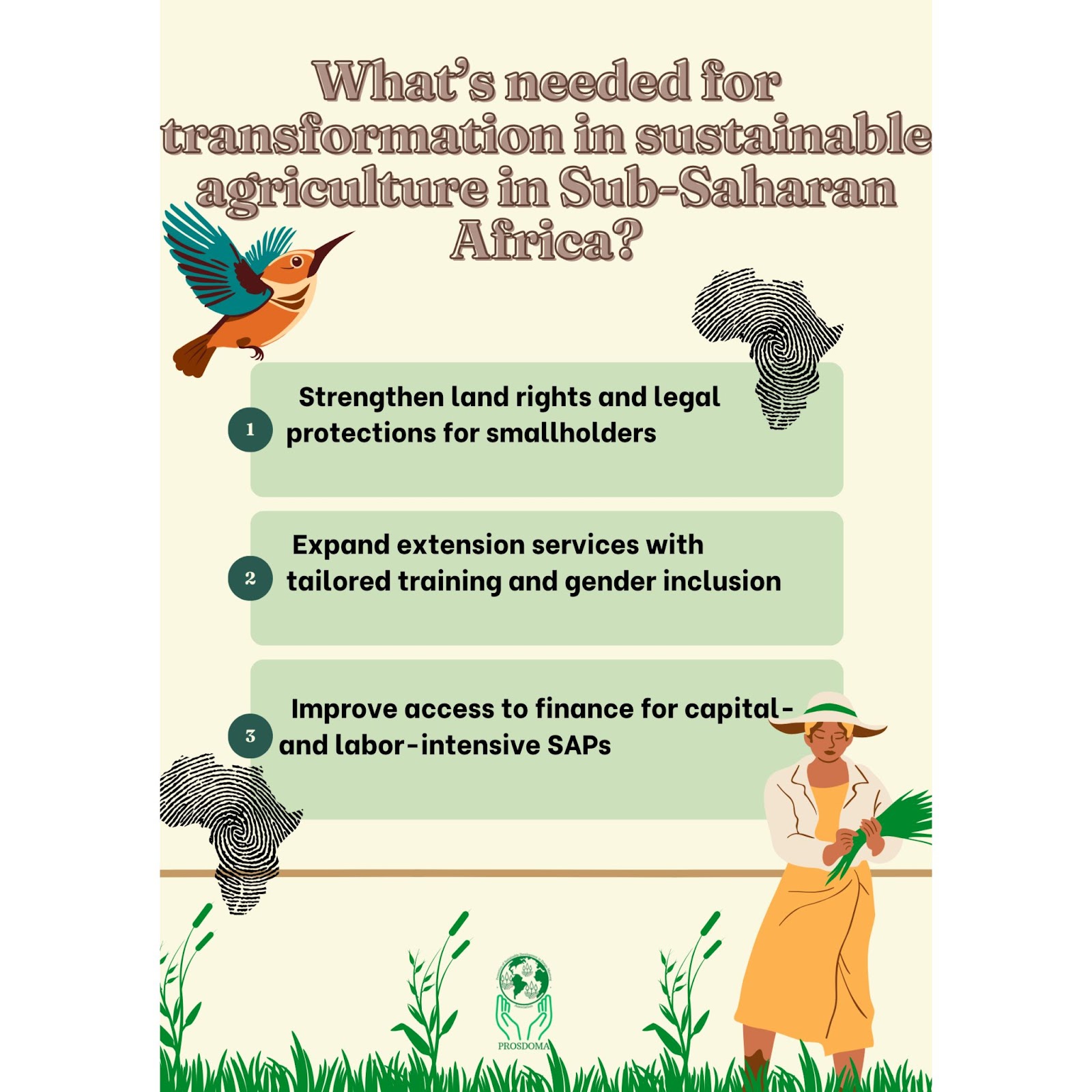
    What’s needed for sustainable transformation?

    1. Strengthen land rights and legal protections for smallholders
    2. Expand extension services with tailored training and gender inclusion
    3. Improve access to finance for capital- and labor-intensive SAPs

    At PROSDOMA, we believe agricultural sustainability is a justice issue. Through our cross-continental initiatives, we aim to empower rural communities with knowledge, tools, and trust. Because the future of food security in Africa begins with farmers—and ends with dignity.

    Join Us: https://old.prosdoma.org/

    By E.D.

    Source:
    Sithole, A. & Olorunfemi, O.D. (2024). Sustainable Agricultural Practices in Sub-Saharan Africa: A Review of Adoption Trends, Impacts, and Challenges Among Smallholder Farmers. Sustainability, 16(22), 9766. https://doi.org/10.3390/su16229766

    #SustainableAgriculture #SAPs #RuralDevelopment #FoodSecurity #ClimateAdaptation #PROSDOMA #AfricaFarming #Agroecology #LandRights #AgriculturalInnovation #SDGs

    What Will It Take to Build a Climate-Resilient Africa? Insights from the AU’s Strategic Climate Investment Roundtable

    As climate threats intensify across the continent, the African Union has taken a bold step: launching its first collective Climate Change and Resilient Development Strategy and Action Plan (2022–2032). But what happens after strategy? Implementation. And for that, partnership is key.

    At the Strategic Climate Investment Partnership Roundtable, held at the AU headquarters in Addis Ababa, stakeholders from governments, civil society, and the private sector came together to turn climate commitments into action.

    The Strategy is guided by 4 core axes:

    1. Strengthening climate governance and policy
    2. Advancing 9 priority development pathways, including food systems, clean energy, and digital transformation
    3. Scaling up implementation capacity and finance access
    4. Leveraging flagship regional initiatives

    From building resilient water systems and sustainable cities to expanding low-carbon transport and climate-smart agriculture, the Strategy focuses on inclusion, equity, and impact. Yet, as the AU notes, real change depends on joint implementation, local ownership, and financing alignment.

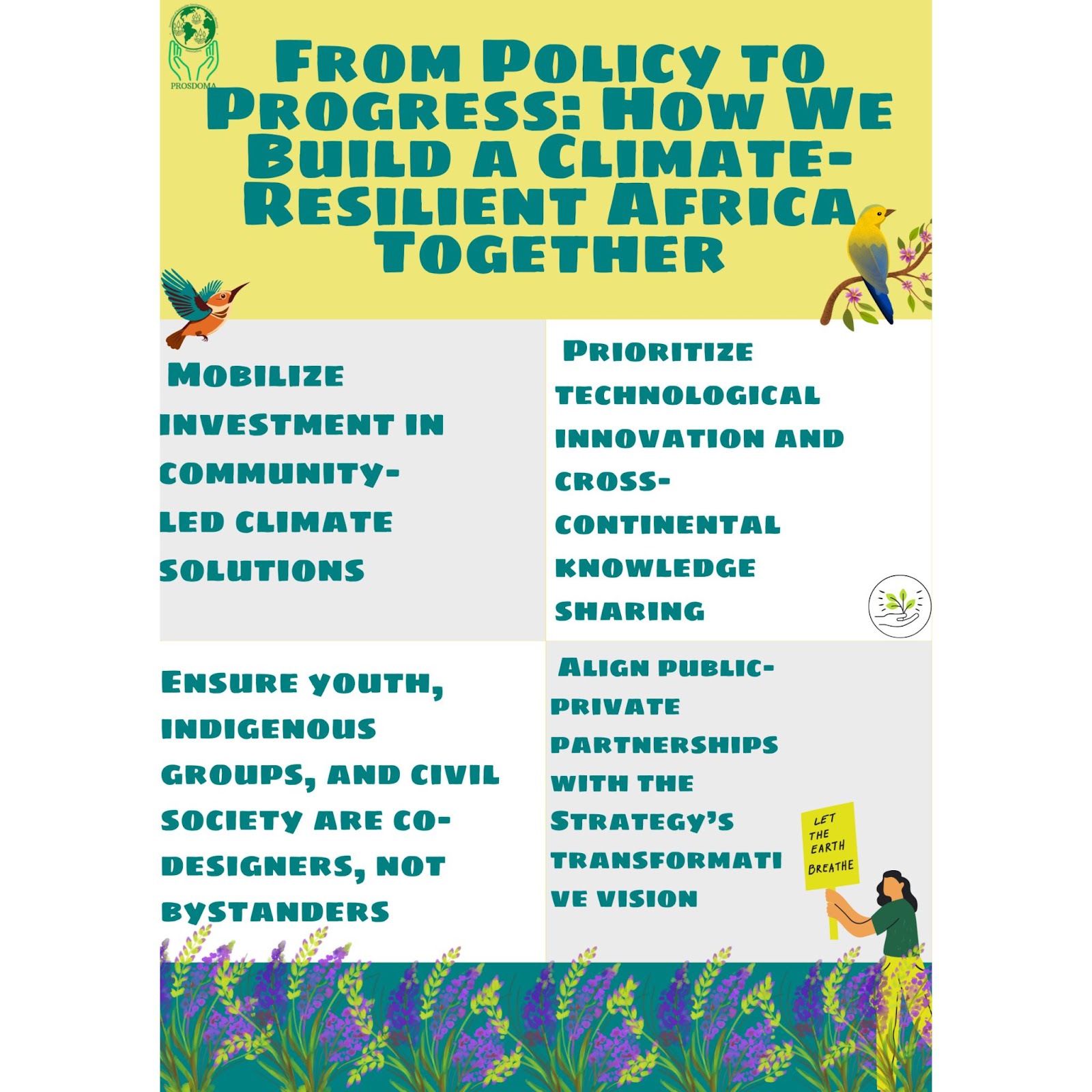
    So what’s next?

    • Mobilize investment in community-led climate solutions
    • Prioritize technological innovation and cross-continental knowledge sharing
    • Ensure youth, indigenous groups, and civil society are co-designers, not bystanders
    • Align public–private partnerships with the Strategy’s transformative vision

    At PROSDOMA, we stand with the vision of a climate-resilient, inclusive, and prosperous Africa. Through our grassroots work and cross-border collaborations, we are proud to contribute to sustainable development that is powered by people, not just policies.

    Join Us: https://old.prosdoma.org/

    By E.D.

    Source:
    African Union Commission. (2023). Strategic Climate Investment Partnership Roundtable Summary. Addis Ababa, Ethiopia.

    #ClimateActionAfrica #AUClimateStrategy #ResilientDevelopment #SustainableAfrica #ClimateJustice #PROSDOMA #InclusivePartnerships #GreenTransition #AdaptationFinance #DigitalTransformation #AfricanUnion #SDGs

    What Can We Learn from Africa’s Farming Systems? A Pathway to Smarter Rural Development

    Did you know that over 58 million people in sub-Saharan Africa’s maize-mixed farming regions live on less than $1.25 a day?

    According to Auricht et al. (2014), Africa’s farming systems reflect more than just crops—they mirror livelihood strategies, infrastructure access, and poverty levels. From agropastoral zones to highland mixed systems, each region faces unique challenges and offers distinct opportunities for targeted agricultural development.

    Key insights from the report:

    • The maize mixed system dominates Eastern, Central, and Southern Africa, home to nearly 100 million rural people.
    • The agropastoral and root/tuber crop systems together account for more than one-third of the rural poor.
    • Some systems (like highland perennial) cover only 2% of land—but house up to 11% of the rural poor.

    Why does this matter?
    Recognizing diverse farming systems allows policymakers to design location-specific interventions—from soil-sensitive fertilizer policies to regionally adapted crops like cowpeas, millet, or dairy.
    It also helps NGOs and development programs like PROSDOMA target capacity building, sustainability training, and livelihood support where it’s needed most.

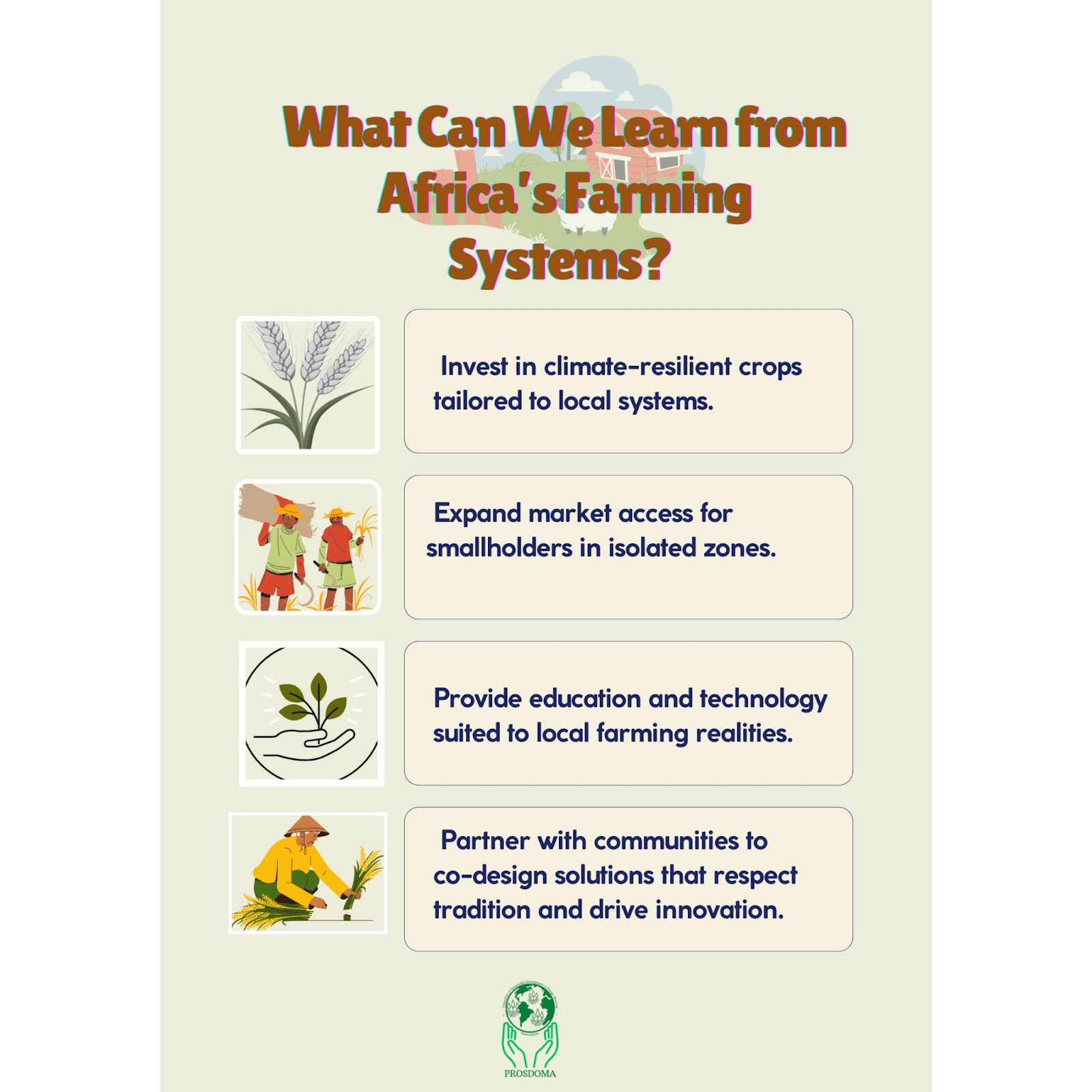
    How can we act smarter?

    1. Invest in climate-resilient crops tailored to local systems.
    2. Expand market access for smallholders in isolated zones.
    3. Provide education and technology suited to local farming realities.
    4. Partner with communities to co-design solutions that respect tradition and drive innovation.

    At PROSDOMA, we believe that true rural development starts with understanding how people live and farm. Our work connects data, dignity, and development across Africa.

    Join Us: https://old.prosdoma.org/

    By E.D.

    Source:
    Auricht, C., Dixon, J., Boffa, J.-M., & Garrity, D. (2014). Farming Systems of Africa, in Atlas of African Agriculture Research and Development. https://doi.org/10.2499/9780896298460_06

    #SustainableAgriculture #RuralDevelopment #FarmingAfrica #FoodSecurity #Agroecology #ClimateResilience #PROSDOMA #DataForDevelopment #InclusiveGrowth #SDGs

    Can Sustainable Agriculture Feed the World—Fairly and Permanently?

    Conventional approaches to food security have often focused narrowly on boosting production, but what about access? What about equity? What about the land itself?

    According to Pretty, Thompson & Hinchcliffe (IIED, 1996), sustainable agriculture is not just an alternative model—it’s a transformative one. Their review of 63 projects across the Global South reveals that sustainable practices—centered on farmer participation, local knowledge, and natural process integration—can double or even triple yields, improve soil health, and reduce dependency on costly external inputs.

    But most importantly, sustainable agriculture:

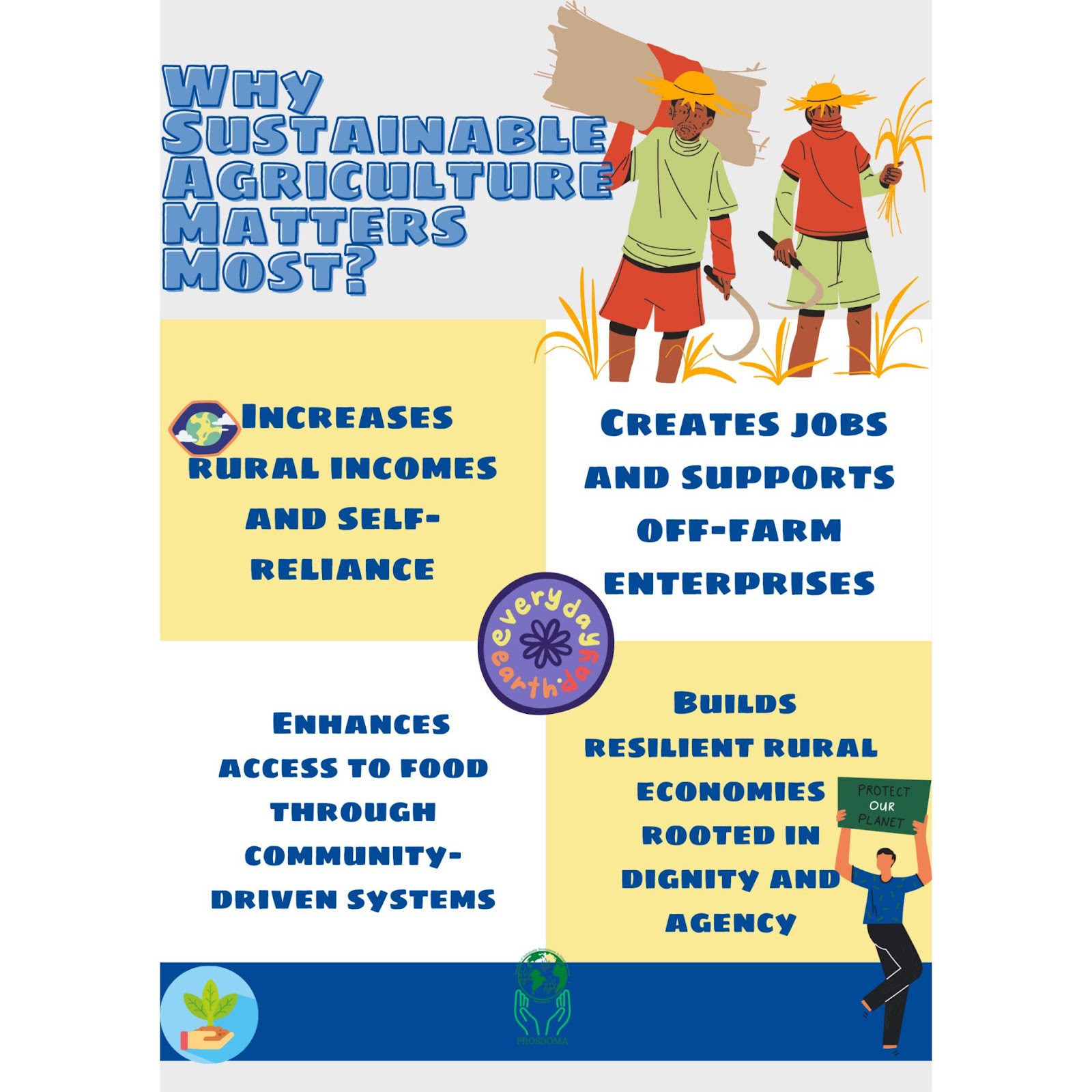
    • Increases rural incomes and self-reliance
    • Creates jobs and supports off-farm enterprises
    • Enhances access to food through community-driven systems
    • Builds resilient rural economies rooted in dignity and agency

    Yet, yield is just part of the picture. Food security also depends on entitlements—people’s ability to access, afford, and control food systems. Sustainable agriculture contributes not just to food availability, but to economic and social justice.

    What do we need to scale this transformation?

    1. Redirect subsidies toward sustainable practices
    2. Invest in farmer-to-farmer learning and women’s leadership
    3. Strengthen land tenure and community rights to resources
    4. Build policies that support regional surplus retention and agro-enterprise

    At PROSDOMA, we believe that agriculture is more than farming—it’s about empowerment, sustainability, and systemic fairness. Whether supporting smallholder farmers in Africa or newcomers in Canada, our mission is to link production with equity.

    Join Us: https://old.prosdoma.org/

    By E.D.

    Source:
    Pretty, J., Thompson, J., & Hinchcliffe, F. (1996). Sustainable Agriculture: Impacts on Food Production and Challenges for Food Security. IIED Gatekeeper Series, No. 60.

    #SustainableAgriculture #FoodSecurity #Agroecology #ClimateJustice #LandRights #PROSDOMA #FarmersFirst #EquitableDevelopment #SDGs #AgroInnovation #EnvironmentalJustice

  • Climate Change & Migration: A Growing Global Challenge

    Climate Change & Migration: A Growing Global Challenge

    Climate change isn’t just an environmental issue – it’s driving internal migration worldwide.  ️ But what does that really mean for communities, economies, and individuals?

    Here’s a breakdown of what’s happening:

     ️ Drought & Aridity on the Rise: Climate change is intensifying drought and arid conditions, making it harder for people to sustain their livelihoods. This is especially true for agriculture-dependent regions, where rural areas face the worst impacts.

      Internal Migration Trends: A recent study found that climate-induced migration often happens within national borders, especially in poorer regions. People are moving from affected areas to urban centers, adding to growing pressures in already-bustling cities.  ️

      Why it Matters:

    • Vulnerable populations (young adults with medium education, for example) are the most likely to migrate in response to climate change.
    • Economic hardship combined with environmental stress creates a powerful incentive for migration.

      The Solution: We need better policies to support both the drivers of migration and the destination regions. This includes providing health services, infrastructure, and social support systems to help cities manage the growing influx of climate migrants. 

    At Prosdoma, we believe in fostering sustainable development that supports both local and global communities. By offering newcomers resources like job search assistance and helping them integrate, we can build stronger communities prepared for the challenges ahead. 

      Join us in creating sustainable futures for both urban and rural populations. Let’s bridge the gap and work towards resilience for all! 

    #ClimateChange #Migration #InternalMigration #Urbanization #SustainableDevelopment #Prosdoma #ClimateAction #ResilienceBuilding #CommunitySupport #ClimateImpact

    Source: https://www.sciencedaily.com/releases/2024/10/241015141458.htm

    AC

  • The Power of Volunteering: Strengthening Communities 

    The Power of Volunteering: Strengthening Communities 

    Volunteering is more than just giving your time – it’s about building stronger, more connected communities. Here’s why YOU should get involved! 

      Fosters Connections: Volunteering brings people together and creates a sense of belonging. When we help others, we help ourselves. 

      Backbone of Social Services: From food banks   to shelters  , volunteers are the unsung heroes who keep essential programs running.

      Increases Resilience: Volunteers help communities bounce back from challenges, making us stronger and more united.

    But here’s the problem… 

    ⚠️ Volunteer Rates Are Dropping: Fewer people are giving their time, and that’s weakening our social safety net. This leads to:

    • Increased loneliness
    • Reduced community services
    • A lack of support for those who need it most

    At Prosdoma, we’re all about empowering newcomers and encouraging them to get involved in their new communities. We help connect people with resources and opportunities to volunteer, creating lasting bonds and a stronger social fabric. 

      Why volunteer?

    • Build meaningful relationships
    • Contribute to a healthier, more sustainable community
    • Make a real impact in the lives of others

    Let’s turn the tide together and create a more inclusive, resilient future for everyone! 

    Ready to start? Head over to Prosdoma and let’s get involved! 

    #Volunteerism #CommunitySupport #SocialImpact #Belonging #Prosdoma #VolunteeringMatters #TogetherWeCan #GiveBack #MakeADifference #Sustainability #ConnectedCommunities

    Source: https://thephilanthropist.ca/2023/09/why-we-need-a-national-conversation-about-volunteering/

    AC

  • The Perils of Migration: What’s at Stake and How We Can Help

    The Perils of Migration: What’s at Stake and How We Can Help

    Migration has always been part of human history, but today, the stakes are higher than ever. For many young people in countries like Senegal, migration seems like the only hope for a better future. The dangerous journey to Europe – often by small, overcrowded boats – claims thousands of lives every year. 

    In Senegal, communities like Bargny are struggling with coastal erosion and a dying fishing industry, making it even harder for locals to find stable livelihoods. For many, migration has become a desperate solution to unemployment, climate change, and lack of opportunity. Families are left waiting, hoping for a phone call from loved ones who may be stranded or lost at sea.  ️

    The new government in Senegal is calling for change – urging young people to stay and build their futures locally. But without proper support, opportunities, and training, many still feel compelled to risk everything for the illusion of a better life abroad. 

    At Prosdoma, we believe in the power of sustainable development and supporting communities. By providing job search assistance, legal resources, and basic skills training to newcomers, we help create strong foundations for a brighter future. 

    Let’s work together to provide education, resources, and sustainable opportunities to prevent desperate migrations and empower both newcomers and local communities. 

    Are you ready to make a difference? Join us in creating a world where migration isn’t the only option! Connect with Prosdoma today to learn how you can help. 

    #MigrationAwareness #SustainableDevelopment #ClimateChange #EconomicOpportunities #Prosdoma #NewcomersSupport #JobCreation #SafeMigration #CommunityBuilding #SocialGood #GlobalChange

    Source:https://www.theguardian.com/global-development/2025/apr/07/barcelona-or-death-mothers-watch-and-wait-as-senegals-men-risk-all-to-reach-europe

    AC

  •  Africa and the Climate Crisis: A Disproportionate Burden

     Africa and the Climate Crisis: A Disproportionate Burden

    Africa contributes the least to global greenhouse gas emissions — yet faces some of the harshest consequences of climate change. From rising sea levels and prolonged droughts to food insecurity and political instability, the continent is on the frontlines of a crisis it didn’t cause.

    Recent research shows that climate change is already undermining Africa’s development prospects, increasing poverty, and placing enormous strain on agriculture, water systems, and human security (Tadesse, 2010).
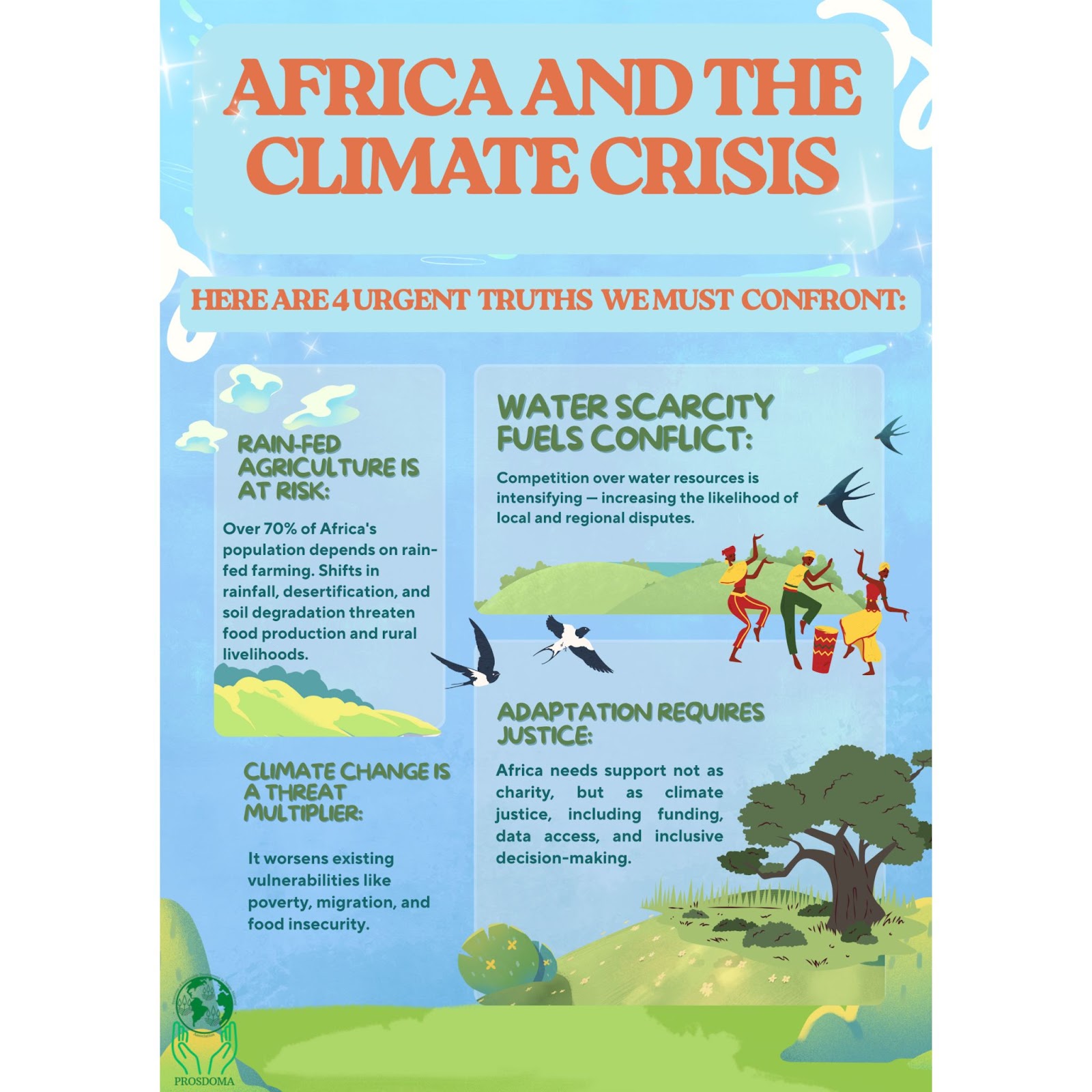
    Here are 4 urgent truths we must confront:

    1️⃣ Rain-fed agriculture is at risk.
    Over 70% of Africa’s population depends on rain-fed farming. Shifts in rainfall, desertification, and soil degradation threaten food production and rural livelihoods.

    2️⃣ Water scarcity fuels conflict.
    Competition over water resources is intensifying — increasing the likelihood of local and regional disputes.

    3️⃣ Climate change is a threat multiplier.
    It worsens existing vulnerabilities like poverty, migration, and food insecurity.

    4️⃣ Adaptation requires justice.
    Africa needs support not as charity, but as climate justice — including funding, data access, and inclusive decision-making.

    So, what can be done?

    ✅ Increase international climate finance directed to African-led solutions
    ✅ Strengthen early warning systems and local adaptation capacity
    ✅ Invest in sustainable agriculture, water access, and youth-led innovation
    ✅ Center African voices in global climate negotiations

    At PROSDOMA, we put these solutions into practice — from supporting agroecology and water education in West Africa to climate literacy and integration support for migrants in Canada.

    Join the mission: prosdoma.org/

    By E.D.

    Source: Tadesse, D. (2010). The Impact of Climate Change in Africa. ISS Paper 220. Institute for Security Studies.
    https://www.issafrica.org

    #ClimateJustice #AfricaClimateCrisis #Prosdoma #SustainableDevelopment #WaterSecurity #AdaptationNow #ClimateAction #FoodSecurity #EnvironmentalEquity #YouthForClimate

    Food Security in Africa: A Call for Long-Term, Community-Led Action
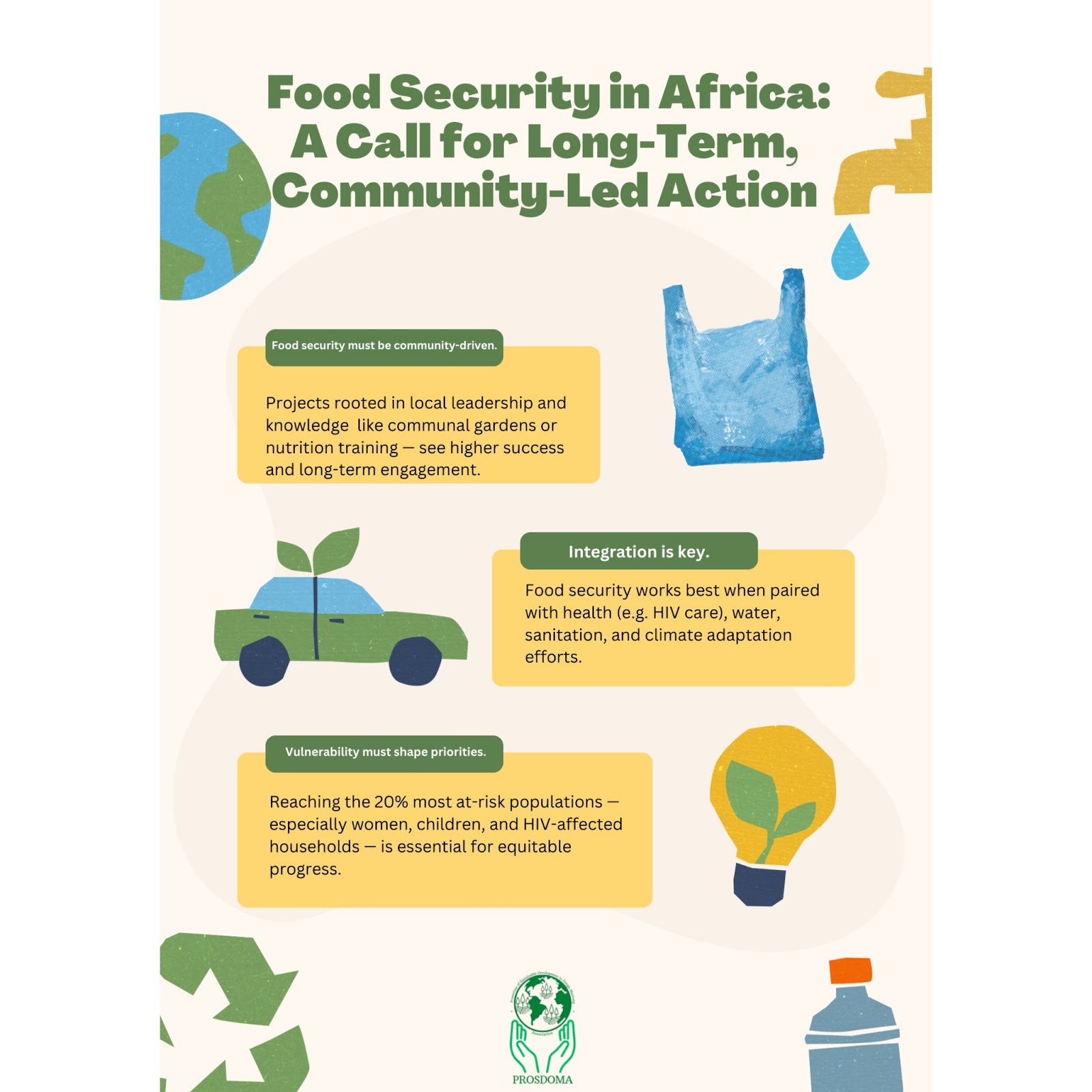
    Climate change, HIV/AIDS, population pressures, and recurring disasters are placing millions of African lives at risk from chronic food insecurity. But short-term fixes won’t solve long-term hunger.

    Recent program data from the International Federation (2008) shows that holistic, integrated approaches are essential for building lasting food security. A five-year strategy engaging 15 African National Societies,  from Uganda to Swaziland emphasized community-based action, multi-sector coordination, and sustained investment.

    4 key takeaways:

    1️⃣ Food security must be community-driven.
    Projects rooted in local leadership and knowledge — like communal gardens or nutrition training — see higher success and long-term engagement.

    2️⃣ Integration is key.
    Food security works best when paired with health (e.g. HIV care), water, sanitation, and climate adaptation efforts.

    3️⃣ Vulnerability must shape priorities.
    Reaching the 20% most at-risk populations, especially women, children, and HIV-affected households, is essential for equitable progress.

    What can be done?
    ✅ Fund long-term national food security plans
    ✅ Support African-led frameworks with local ownership
    ✅ Link food, health, and disaster preparedness strategies
    ✅ Empower grassroots institutions to lead

    At PROSDOMA, we apply these principles every day from regenerative farming in Cameroon to food justice education for newcomers in Canada. We know that resilience grows from the roots up.

    Learn more or partner with us: prosdoma.org/

    By E.D.

    Source: International Federation of Red Cross and Red Crescent Societies. (2008). Food Security in Africa. Appeal No. MAA00023. https://www.ifrc.org/docs/appeals/annual08/MAA0002308pu1f.pdf

    #FoodSecurity #AfricaDevelopment #ClimateJustice #HIVandHunger #IntegratedApproach #Prosdoma #CommunityResilience #Agroecology #WaterSanitationHealth #LongTermImpact #DisasterPreparedness

    Sustainability in Africa: Beyond Land, Beyond Yields

    Africa is rich in natural resources, cultural diversity, and ecological potential. Yet environmental degradation, social inequalities, and the impacts of climate change continue to limit the continent’s capacity to develop equitably and sustainably.

    Recent research highlights that while agricultural modernization is increasing production, it also exacerbates land degradation, water stress, and social exclusion, particularly among the landless poor (Whitfield, 2016).
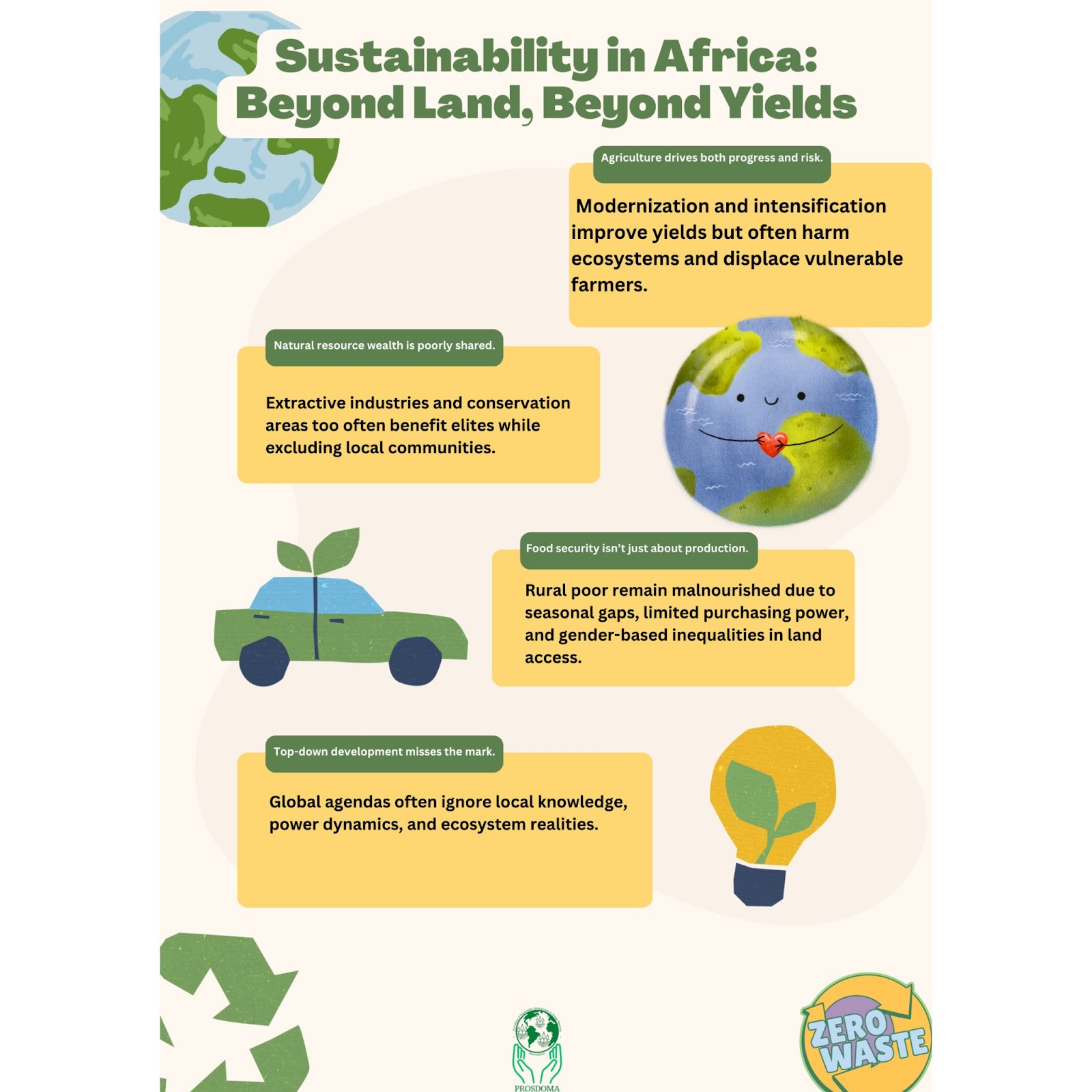
    4 key takeaways:

    1️⃣ Agriculture drives both progress and risk.
    Modernization and intensification improve yields but often harm ecosystems and displace vulnerable farmers.

    2️⃣ Natural resource wealth is poorly shared.
    Extractive industries and conservation areas too often benefit elites while excluding local communities.

    3️⃣ Food security isn’t just about production.
    Rural poor remain malnourished due to seasonal gaps, limited purchasing power, and gender-based inequalities in land access.

    4️⃣ Top-down development misses the mark.
    Global agendas often ignore local knowledge, power dynamics, and ecosystem realities.

    What can be done?

    ✅ Support agroecology and land rights for smallholders
    ✅ Integrate food, energy, and water planning
    ✅ Fund community-led conservation, not just carbon credits
    ✅ Ensure women and youth lead sustainability transitions

    At PROSDOMA, we turn these insights into action. Whether restoring land in West Africa or promoting equitable access to food and resources in Canada, we root sustainability in justice, not just in metrics.

    Learn more: prosdoma.org/

    By E.D.

    Source: Whitfield, S. (2016). Environmental and Social Sustainability in Africa. ISPI Background Paper No. 2.https://www.ispionline.it

    #SustainabilityInAfrica #Agroecology #ClimateJustice #FoodSecurity #NaturalResourceEquity #Prosdoma #EnvironmentalGovernance #AfricaDevelopment #LandRights #CommunityLedDevelopment

    Smart Water, Smarter Futures: How AI Is Reshaping Water Management

    Water utilities worldwide face a dual crisis: aging infrastructure and rising climate uncertainty. But artificial intelligence (AI) offers a powerful path forward  if used strategically.

    Recent research from the Asian Development Bank shows that AI can significantly improve leak detection, demand forecasting, and energy efficiency, saving utilities up to 11% in annual costs while advancing climate resilience and SDG 6 (ADB, 2020).
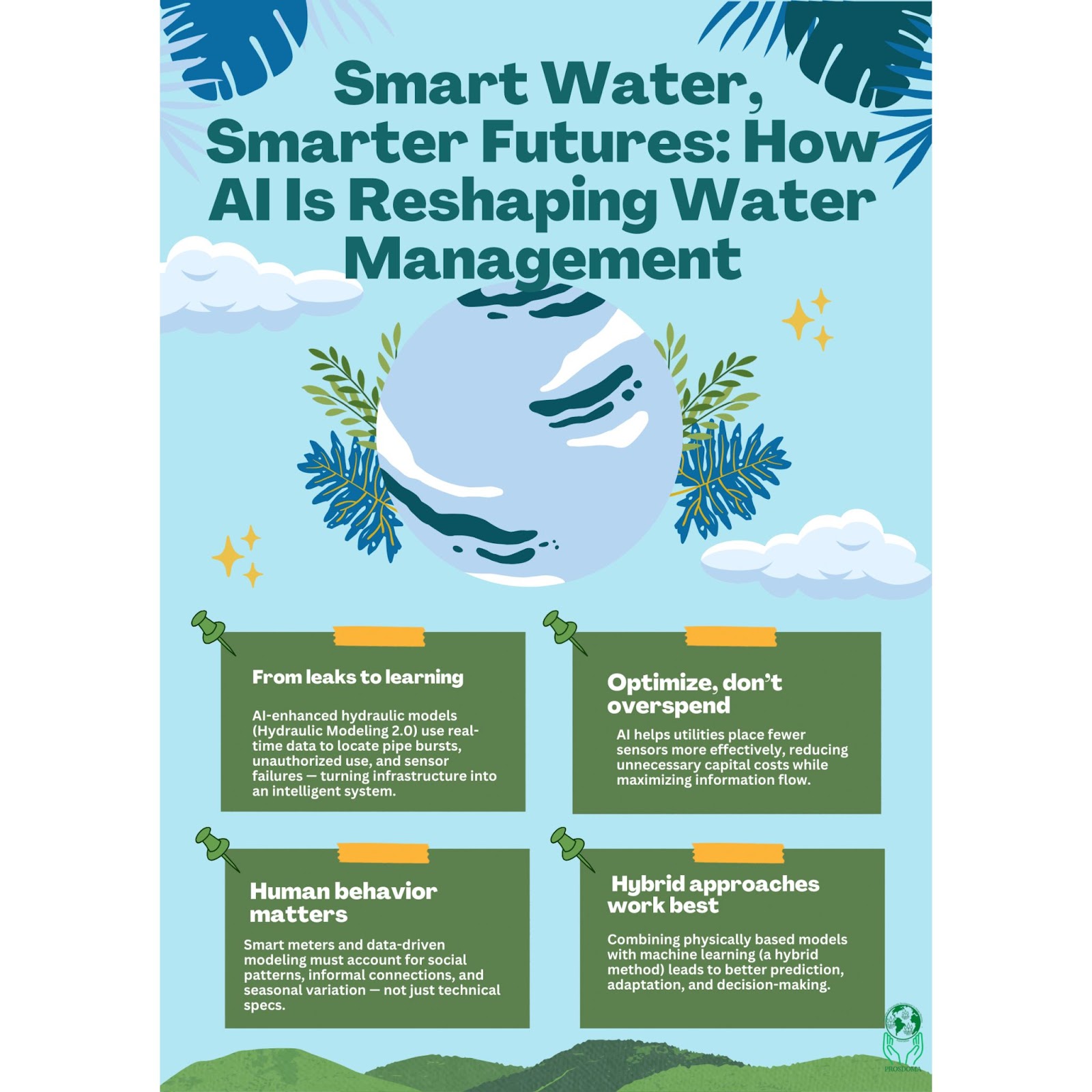
    Here are 4 key insights:

    1️⃣ From leaks to learning.
    AI-enhanced hydraulic models (Hydraulic Modeling 2.0) use real-time data to locate pipe bursts, unauthorized use, and sensor failures, turning infrastructure into an intelligent system.

    2️⃣ Optimize, don’t overspend.
    AI helps utilities place fewer sensors more effectively, reducing unnecessary capital costs while maximizing information flow.

    3️⃣ Human behavior matters.
    Smart meters and data-driven modeling must account for social patterns, informal connections, and seasonal variation, not just technical specs.

    4️⃣ Hybrid approaches work best.
    Combining physically based models with machine learning (a hybrid method) leads to better prediction, adaptation, and decision-making.

    What can be done?
    ✅ Invest in AI pilot programs for water utilities
    ✅ Promote affordable ICT systems for Global South cities
    ✅ Link digital water tools with public trust and ethics
    ✅ Support training and inclusive governance in smart infrastructure

    At PROSDOMA, we champion climate-tech solutions that prioritize both innovation and justice. Whether it’s smart irrigation in Africa or water literacy for newcomers in Canada — we believe tech must serve people first.

    Join us: prosdoma.org/

    By E.D.

    Source: Asian Development Bank (2020). Using Artificial Intelligence for Smart Water Management Systems (ADB Brief No. 143). https://doi.org/10.22617/BRF200191-2

    #SmartWater #AIforGood #WaterManagement #ClimateAdaptation #Prosdoma #SustainableInfrastructure #HydraulicModeling #SDG6 #DigitalTransformation #WaterEquity

    When a Tree Grows in School, a Future Takes Root

    Planting trees in schools does more than green the landscape,  it cultivates climate awareness, food security, and community resilience.

    Recent educational guides from Regreening Africa emphasize the transformative role of tree planting in African schools. These programs not only teach environmental stewardship, but also provide shade, nutrition, livelihoods, and learning opportunities (Koech et al., 2022).
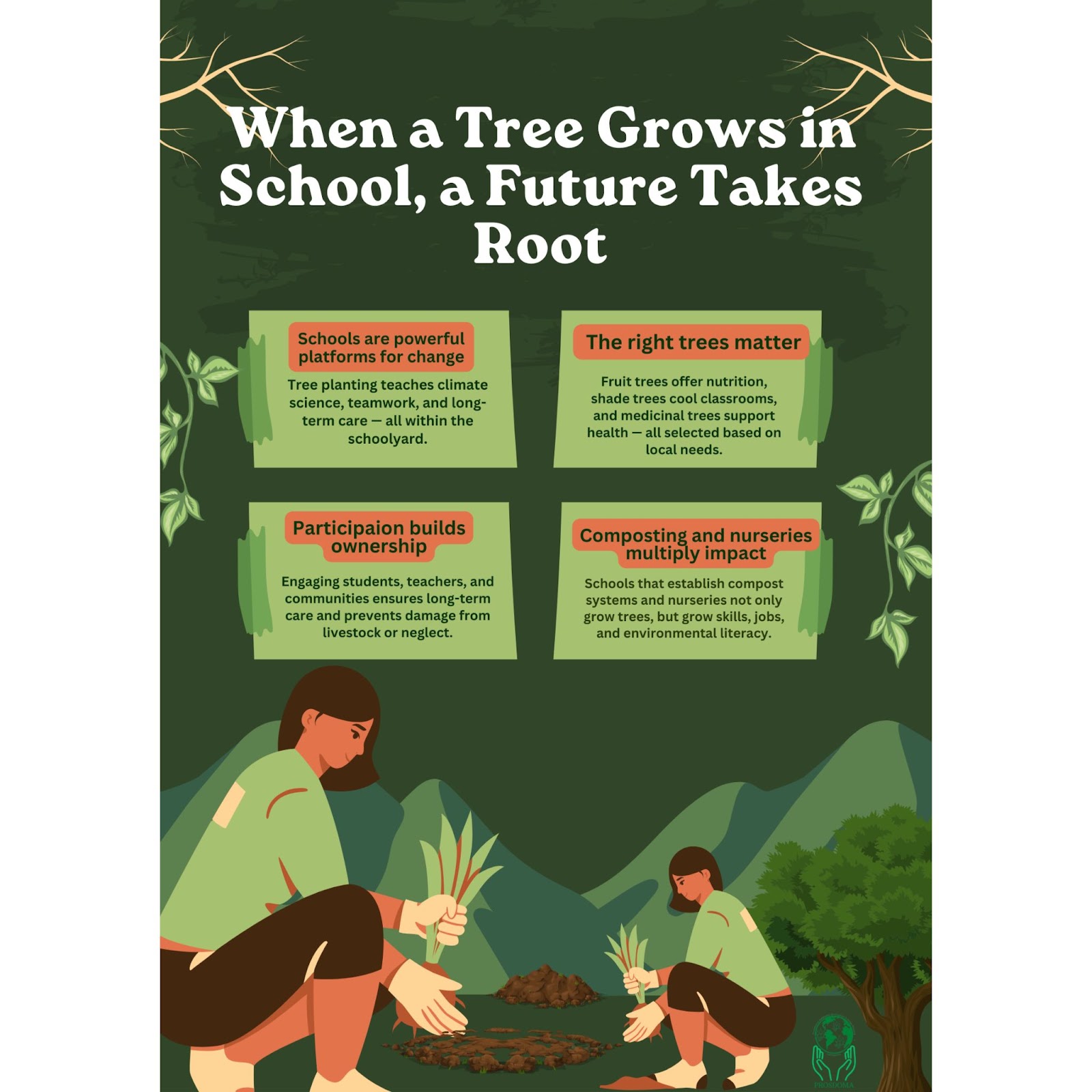
    4 key takeaways:

    1️⃣ Schools are powerful platforms for change.
    Tree planting teaches climate science, teamwork, and long-term care — all within the schoolyard.

    2️⃣ The right trees matter.
    Fruit trees offer nutrition, shade trees cool classrooms, and medicinal trees support health, all selected based on local needs.

    3️⃣ Participation builds ownership.
    Engaging students, teachers, and communities ensures long-term care and prevents damage from livestock or neglect.

    4️⃣ Composting and nurseries multiply impact.
    Schools that establish compost systems and nurseries not only grow trees, but grow skills, jobs, and environmental literacy.

    What can be done?

    ✅ Support school-based agroforestry education
    ✅ Fund school nurseries and climate clubs
    ✅ Promote girls’ leadership in environmental action
    ✅ Integrate tree planting into national education strategies

    At PROSDOMA, we believe that classrooms can be climate labs. From planting trees in African villages to teaching climate justice in Canadian schools, we root learning in the land.

    Join our mission: prosdoma.org/contact

    By E.D.

    Source: Koech, G., Tengetile, Z. M., & Bourne, M. (2022). Guide on Planting Trees in Schools. World Agroforestry (ICRAF), Nairobi, Kenya.

    #TreePlanting #SchoolForestry #ClimateEducation #GreenSchools #Agroforestry #Prosdoma #EnvironmentalLiteracy #YouthForClimate #FoodSecurity #NatureInEducation #RegreeningAfrica

    #prosdoma 

  • Migration: A Path to Sustainable Development for All

    Migration: A Path to Sustainable Development for All

    Migration is often viewed through a lens of crisis, but did you know it can be a model for sustainable development?   With the world facing climate change, conflict, and economic disparities, migration offers a solution that benefits everyone – if managed well. 

    Here’s why migration can drive positive outcomes:

    1. A major driver of development  – Migration fuels economic growth, prosperity, and job creation. In 2020, international remittances totaled $670 billion, which is more than foreign investments in many low- and middle-income countries.
    2. Global labor markets  – With labor shortages costing economies $1.3 trillion annually, migration is key to addressing these gaps. By matching available talent with job opportunities, we can drive growth and fill crucial roles across sectors.
    3. Demographic shifts   – Aging populations in developed nations, combined with the young and growing workforce in regions like Africa, create a demand for migration to fill labor shortages and harness global talent.
    4. A sustainable model for all  – Expanding safe, regular migration pathways can reduce pressure on asylum systems, provide better skills alignment, and create economic opportunities that benefit migrants and destination countries alike.

    At Prosdoma, we work with newcomers in Alberta, Canada, helping them build their new lives through integration support, skills development, and creating connections to resources. By supporting migration pathways and embracing the strengths of migrants, we contribute to a sustainable future for everyone. 

    Let’s unlock the potential of migration and turn it into an opportunity for growth, unity, and a better tomorrow. Ready to get involved? Reach out to Prosdoma today! 

    #MigrationMatters #SustainableDevelopment #MigrationForAll #EconomicGrowth #SkillsDevelopment #Prosdoma #CommunityBuilding #ClimateChange #GlobalTalent #NewOpportunities #InclusiveFuture

    Source:https://www.weforum.org/stories/2024/01/migration-model-sustainable-development/

    AC

  • The Power of Volunteering

    The Power of Volunteering

    Volunteering is more than just giving your time – it’s about creating connections, building stronger communities, and improving your own well-being.   Whether you’re new to an area or looking to make a positive impact, volunteering offers a unique chance to contribute to causes that matter.

    Here’s why you should consider volunteering:

    1. Build Connections – Volunteering helps you meet new people, expand your network, and strengthen your social bonds. It’s a great way to create meaningful relationships within your community.
    2. Boost Your Mental & Physical Health – Did you know volunteering can lower stress and combat depression? Plus, it’s linked to better physical health and a longer life.
    3. Advance Your Career – Volunteering helps you develop essential workplace skills like communication, problem-solving, and project management. It can even open doors to new career opportunities!
    4. Fulfillment & Happiness – Giving back boosts your self-confidence and can make you feel incredibly fulfilled. Studies show that volunteers are happier and more satisfied with their lives.

    At Prosdoma, we believe in the power of community. Volunteering is not only about helping others, but it’s also about building a stronger, more sustainable future for all. Whether you’re supporting newcomers to Alberta  , helping in Africa  , or working toward a more sustainable environment  , your time makes a difference.

    Ready to make an impact? Start volunteering today and join us in creating a better tomorrow! 

    #CommunityBuilding #Volunteer #Prosdoma #SocialImpact #MentalHealth #CareerDevelopment #Sustainability #GiveBack #VolunteerPower #EcoFriendly #PositiveChange

    Source:https://www.wcsu.edu/community-engagement/benefits-of-volunteering/

    AC

  • Think you know migration?

    Think you know migration?

    Here are 3 common myths—and the real facts behind them.

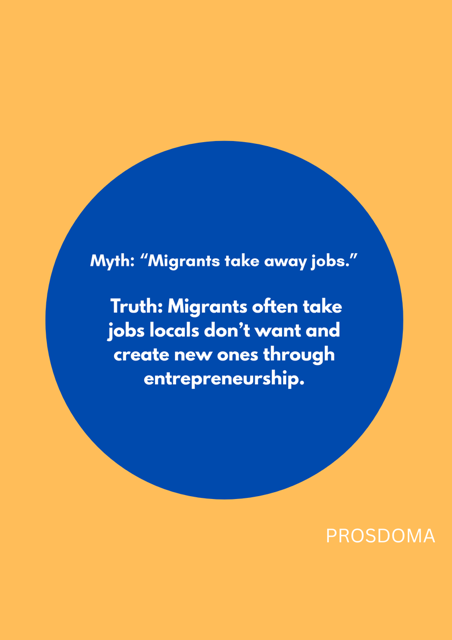
     .png “Migrants take away jobs.”

    ✅.png Truth: Migrants often take jobs locals don’t want and create new ones through entrepreneurship.

     .pngMost migrants are unskilled.”

    ✅.png Truth: Many bring diverse skills and education, filling gaps in healthcare, tech, and more.

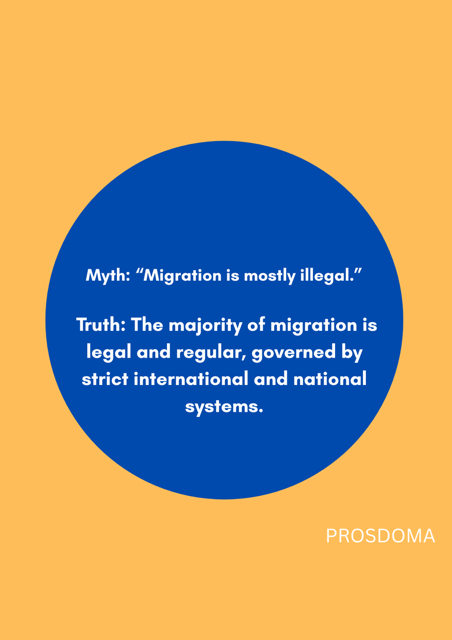
     .png “Migration is mostly illegal.”

    ✅.png Truth: The majority of migration is legal and regular, governed by strict international and national systems.

    #migrationfacts

    NN