Can AI Revolutionize Agriculture Without Leaving Small Farmers Behind?
As artificial intelligence (AI) reshapes nearly every industry, agriculture faces a pivotal moment. According to the CAST 2025 report, AI is unlocking game-changing opportunities in crop yield prediction, livestock monitoring, weed control, and even food safety—but also revealing a digital divide between large agribusinesses and smallholder farmers.
The report highlights several key use cases:
- ExtensionBot, a generative AI trained on 360,000+ agricultural documents, delivers precise, local farming advice.
- See and Spray AI reduces herbicide use by targeting individual weeds with image recognition.
- FRAIL-bots assist harvesters in the field, boosting productivity and reducing physical strain.
- AI even helps detect counterfeit wine and enhance crop nutrition through microbiome data.
Yet major challenges remain:
- Data incompatibility, weak rural connectivity, and privacy concerns hinder adoption.
- Many AI models fail to adapt across regions or crops.
- Farmers fear losing both data ownership and traditional knowledge.
- The rural workforce needs urgent AI training and inclusion.
What can we do to democratize agri-AI?
- Promote explainable, farmer-friendly AI tools
- Fund open-source platforms and farmer-driven innovation
- Expand AI-focused agricultural education
- Respect traditional wisdom while building digital capacity
At PROSDOMA, we believe innovation must be inclusive. That’s why we support not just tech deployment, but community empowerment. From Sub-Saharan Africa to rural Canada, we’re committed to building a future where AI enhances dignity, knowledge, and food justice.
Join Us: https://old.prosdoma.org/
By E.D.
Source:
CAST. (2025). AI in Agriculture: Opportunities, Challenges, and Recommendations.
#AgriTech #AIinAgriculture #SmartFarming #DigitalInclusion #FoodSecurity #PROSDOMA #ClimateSmartAgriculture #RuralEmpowerment #AIforGood #PrecisionFarming #SustainableInnovation
#prosdoma 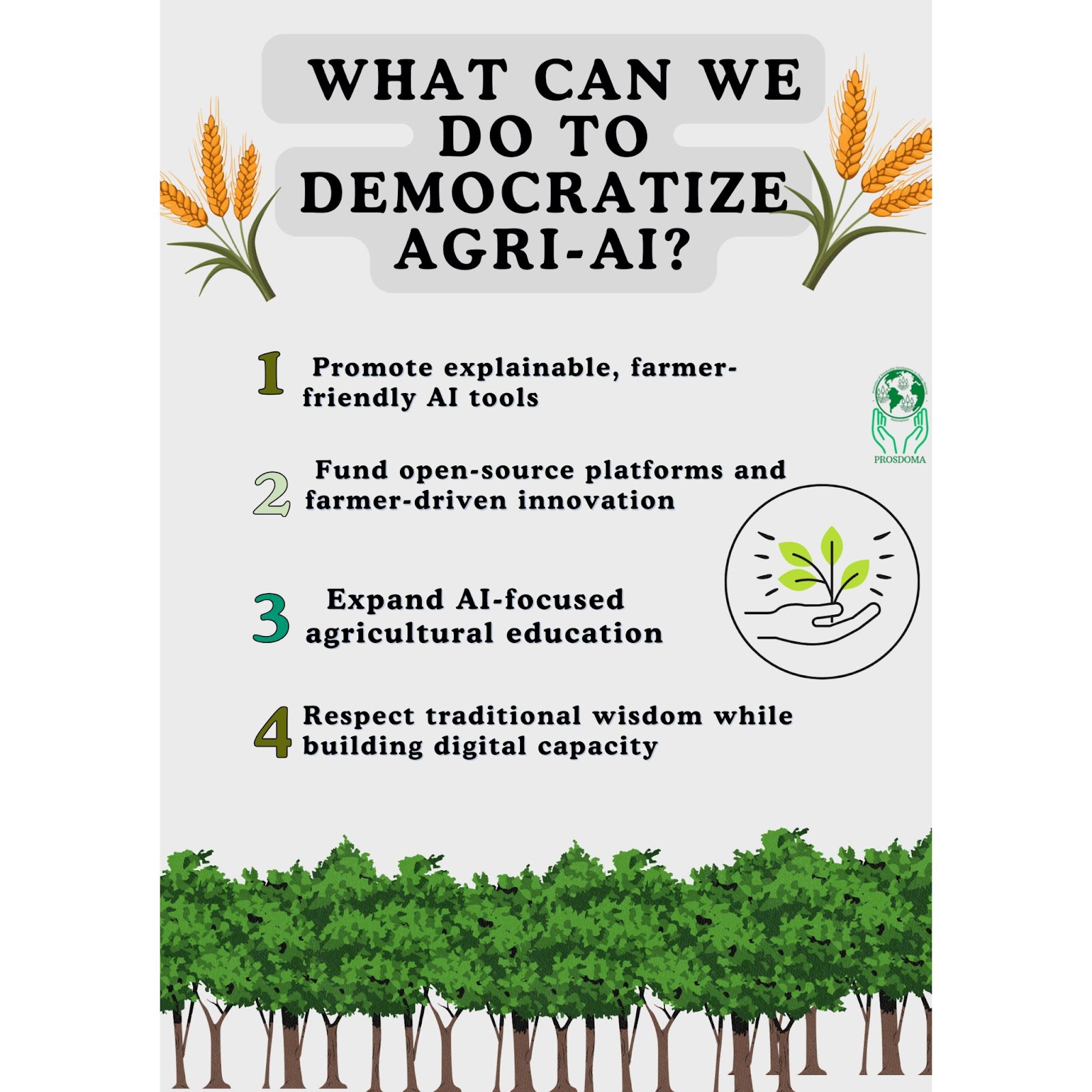
Can Sustainable Agriculture Transform Sub-Saharan Africa? A Closer Look at What Works—and What Doesn’t
Agriculture sustains up to 90% of the rural population in Sub-Saharan Africa (SSA), yet smallholder farmers face compounding crises: climate variability, soil degradation, pest outbreaks, and food insecurity.
A systematic review by Sithole & Olorunfemi (2024) highlights how Sustainable Agricultural Practices (SAPs)—like crop rotation, intercropping, water harvesting, mulching, and agroforestry—offer practical, science-backed solutions to increase resilience and productivity.
Key findings:
- SAPs significantly boost yields, soil health, and household income
- Adoption is higher in East Africa (e.g., Ethiopia, Kenya) than in West and Southern Africa
- Agroforestry, improved seed varieties, and water harvesting are among the most promising innovations
But challenges persist:
- Land tenure insecurity, lack of training, gender disparities
- Weak rural advisory systems and limited access to finance
- Farmers’ hesitation due to slow return on investment
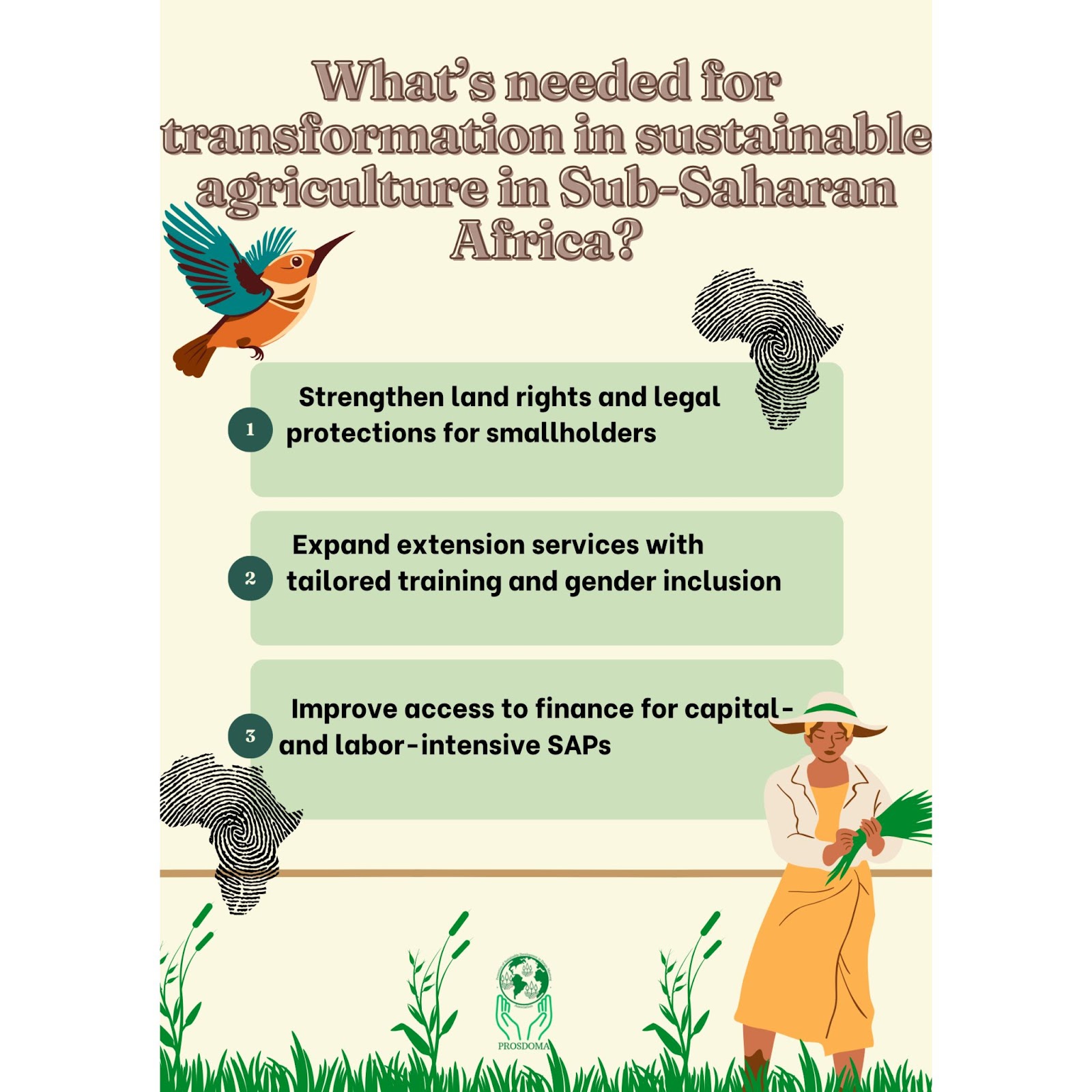
What’s needed for sustainable transformation?
- Strengthen land rights and legal protections for smallholders
- Expand extension services with tailored training and gender inclusion
- Improve access to finance for capital- and labor-intensive SAPs
At PROSDOMA, we believe agricultural sustainability is a justice issue. Through our cross-continental initiatives, we aim to empower rural communities with knowledge, tools, and trust. Because the future of food security in Africa begins with farmers—and ends with dignity.
Join Us: https://old.prosdoma.org/
By E.D.
Source:
Sithole, A. & Olorunfemi, O.D. (2024). Sustainable Agricultural Practices in Sub-Saharan Africa: A Review of Adoption Trends, Impacts, and Challenges Among Smallholder Farmers. Sustainability, 16(22), 9766. https://doi.org/10.3390/su16229766
#SustainableAgriculture #SAPs #RuralDevelopment #FoodSecurity #ClimateAdaptation #PROSDOMA #AfricaFarming #Agroecology #LandRights #AgriculturalInnovation #SDGs
What Will It Take to Build a Climate-Resilient Africa? Insights from the AU’s Strategic Climate Investment Roundtable
As climate threats intensify across the continent, the African Union has taken a bold step: launching its first collective Climate Change and Resilient Development Strategy and Action Plan (2022–2032). But what happens after strategy? Implementation. And for that, partnership is key.
At the Strategic Climate Investment Partnership Roundtable, held at the AU headquarters in Addis Ababa, stakeholders from governments, civil society, and the private sector came together to turn climate commitments into action.
The Strategy is guided by 4 core axes:
- Strengthening climate governance and policy
- Advancing 9 priority development pathways, including food systems, clean energy, and digital transformation
- Scaling up implementation capacity and finance access
- Leveraging flagship regional initiatives
From building resilient water systems and sustainable cities to expanding low-carbon transport and climate-smart agriculture, the Strategy focuses on inclusion, equity, and impact. Yet, as the AU notes, real change depends on joint implementation, local ownership, and financing alignment.
So what’s next?
- Mobilize investment in community-led climate solutions
- Prioritize technological innovation and cross-continental knowledge sharing
- Ensure youth, indigenous groups, and civil society are co-designers, not bystanders
- Align public–private partnerships with the Strategy’s transformative vision
At PROSDOMA, we stand with the vision of a climate-resilient, inclusive, and prosperous Africa. Through our grassroots work and cross-border collaborations, we are proud to contribute to sustainable development that is powered by people, not just policies.
Join Us: https://old.prosdoma.org/
By E.D.
Source:
African Union Commission. (2023). Strategic Climate Investment Partnership Roundtable Summary. Addis Ababa, Ethiopia.
#ClimateActionAfrica #AUClimateStrategy #ResilientDevelopment #SustainableAfrica #ClimateJustice #PROSDOMA #InclusivePartnerships #GreenTransition #AdaptationFinance #DigitalTransformation #AfricanUnion #SDGs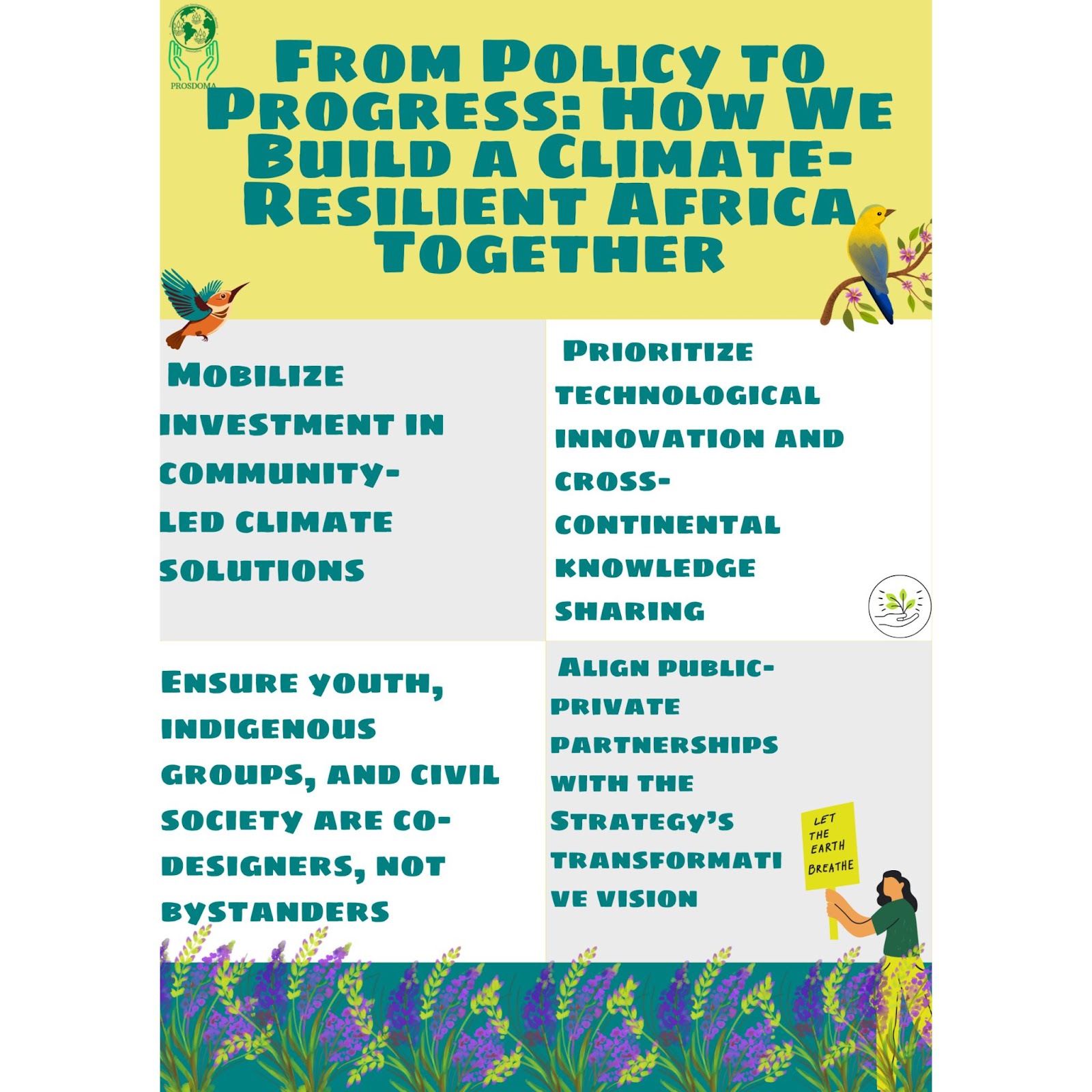
What Can We Learn from Africa’s Farming Systems? A Pathway to Smarter Rural Development
Did you know that over 58 million people in sub-Saharan Africa’s maize-mixed farming regions live on less than $1.25 a day?
According to Auricht et al. (2014), Africa’s farming systems reflect more than just crops—they mirror livelihood strategies, infrastructure access, and poverty levels. From agropastoral zones to highland mixed systems, each region faces unique challenges and offers distinct opportunities for targeted agricultural development.
Key insights from the report:
- The maize mixed system dominates Eastern, Central, and Southern Africa, home to nearly 100 million rural people.
- The agropastoral and root/tuber crop systems together account for more than one-third of the rural poor.
- Some systems (like highland perennial) cover only 2% of land—but house up to 11% of the rural poor.
Why does this matter?
Recognizing diverse farming systems allows policymakers to design location-specific interventions—from soil-sensitive fertilizer policies to regionally adapted crops like cowpeas, millet, or dairy.
It also helps NGOs and development programs like PROSDOMA target capacity building, sustainability training, and livelihood support where it’s needed most.
How can we act smarter?
- Invest in climate-resilient crops tailored to local systems.
- Expand market access for smallholders in isolated zones.
- Provide education and technology suited to local farming realities.
- Partner with communities to co-design solutions that respect tradition and drive innovation.
At PROSDOMA, we believe that true rural development starts with understanding how people live and farm. Our work connects data, dignity, and development across Africa.
Join Us: https://old.prosdoma.org/
By E.D.
Source:
Auricht, C., Dixon, J., Boffa, J.-M., & Garrity, D. (2014). Farming Systems of Africa, in Atlas of African Agriculture Research and Development. https://doi.org/10.2499/9780896298460_06
#SustainableAgriculture #RuralDevelopment #FarmingAfrica #FoodSecurity #Agroecology #ClimateResilience #PROSDOMA #DataForDevelopment #InclusiveGrowth #SDGs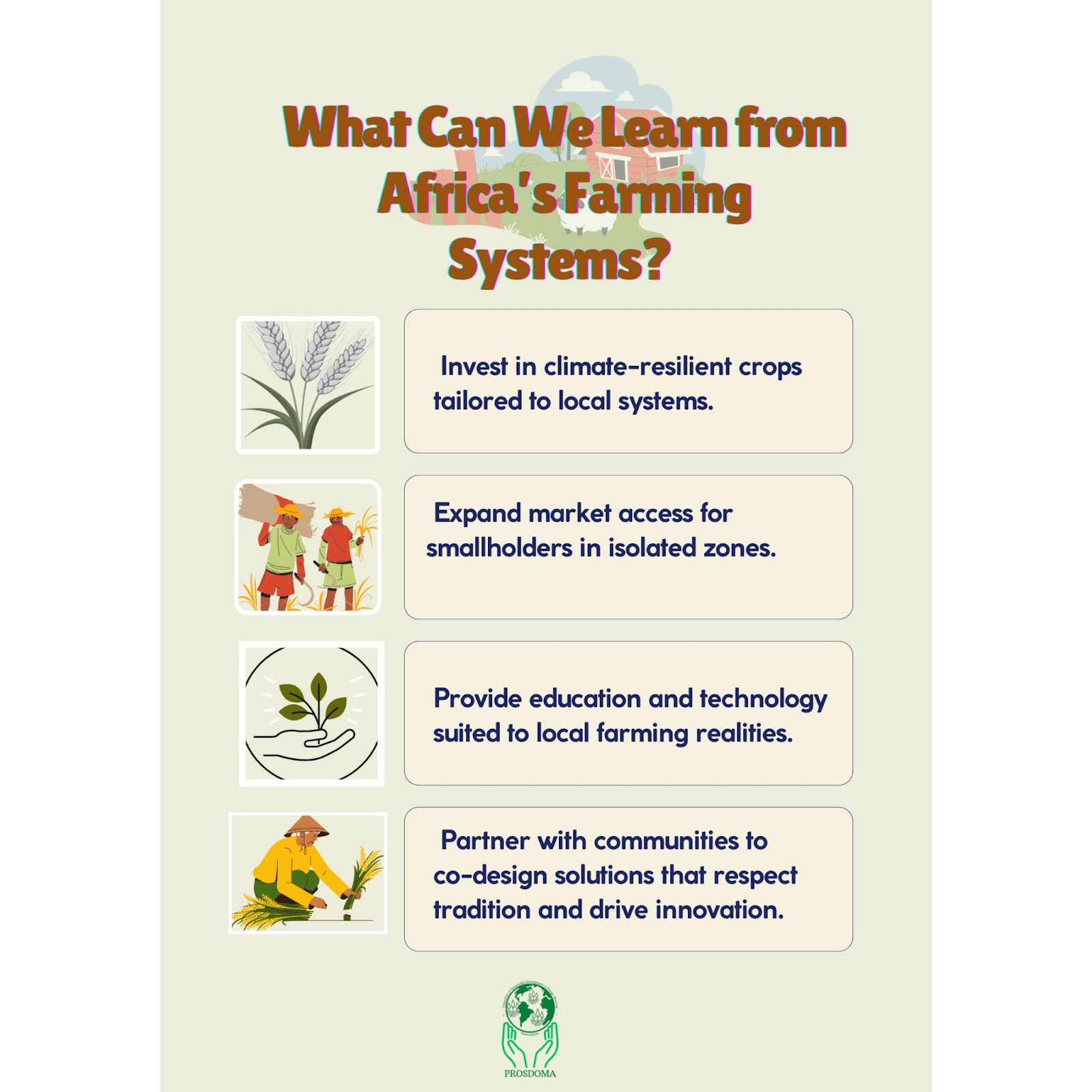
Can Sustainable Agriculture Feed the World—Fairly and Permanently?
Conventional approaches to food security have often focused narrowly on boosting production, but what about access? What about equity? What about the land itself?
According to Pretty, Thompson & Hinchcliffe (IIED, 1996), sustainable agriculture is not just an alternative model—it’s a transformative one. Their review of 63 projects across the Global South reveals that sustainable practices—centered on farmer participation, local knowledge, and natural process integration—can double or even triple yields, improve soil health, and reduce dependency on costly external inputs.
But most importantly, sustainable agriculture:
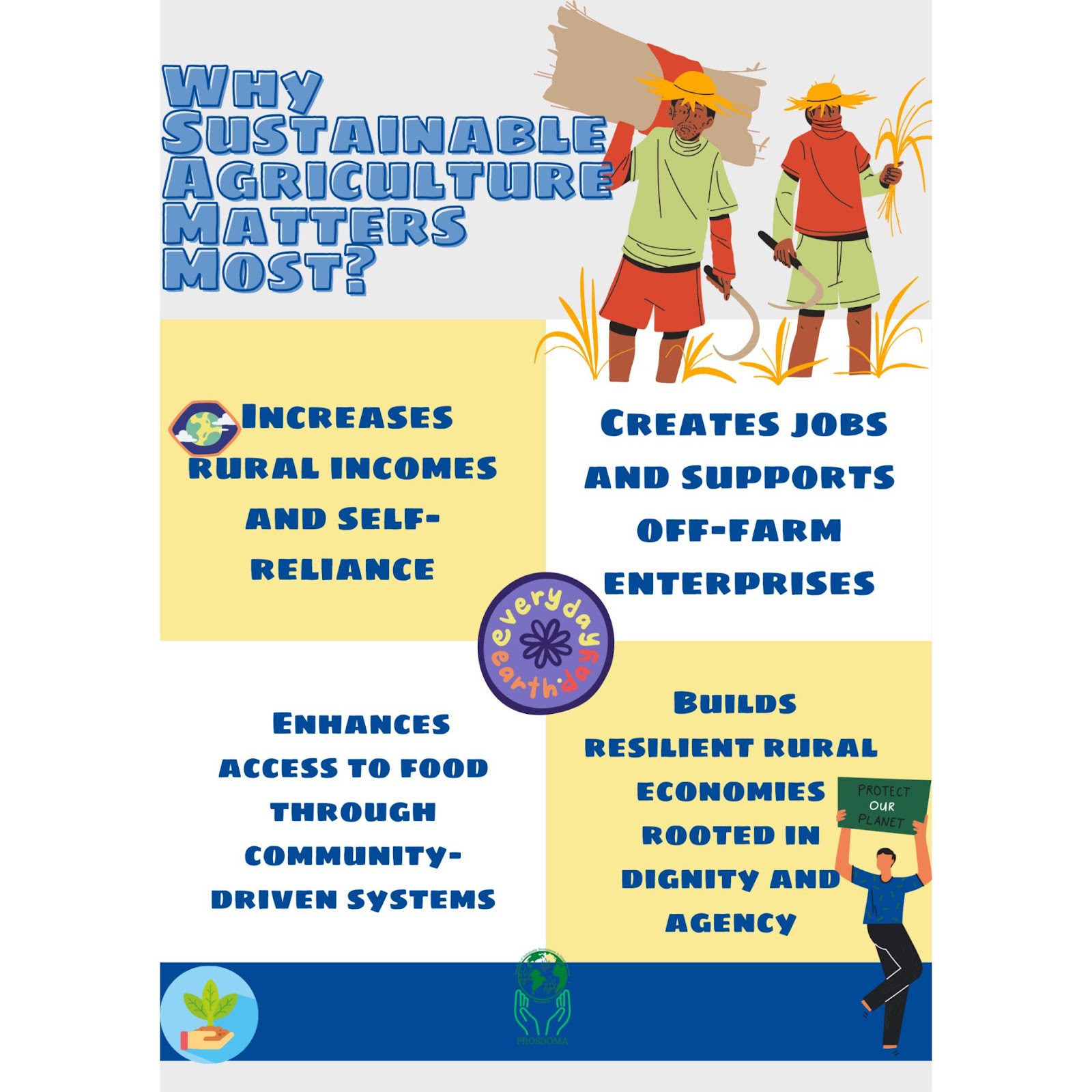
- Increases rural incomes and self-reliance
- Creates jobs and supports off-farm enterprises
- Enhances access to food through community-driven systems
- Builds resilient rural economies rooted in dignity and agency
Yet, yield is just part of the picture. Food security also depends on entitlements—people’s ability to access, afford, and control food systems. Sustainable agriculture contributes not just to food availability, but to economic and social justice.
What do we need to scale this transformation?
- Redirect subsidies toward sustainable practices
- Invest in farmer-to-farmer learning and women’s leadership
- Strengthen land tenure and community rights to resources
- Build policies that support regional surplus retention and agro-enterprise
At PROSDOMA, we believe that agriculture is more than farming—it’s about empowerment, sustainability, and systemic fairness. Whether supporting smallholder farmers in Africa or newcomers in Canada, our mission is to link production with equity.
Join Us: https://old.prosdoma.org/
By E.D.
Source:
Pretty, J., Thompson, J., & Hinchcliffe, F. (1996). Sustainable Agriculture: Impacts on Food Production and Challenges for Food Security. IIED Gatekeeper Series, No. 60.
#SustainableAgriculture #FoodSecurity #Agroecology #ClimateJustice #LandRights #PROSDOMA #FarmersFirst #EquitableDevelopment #SDGs #AgroInnovation #EnvironmentalJustice

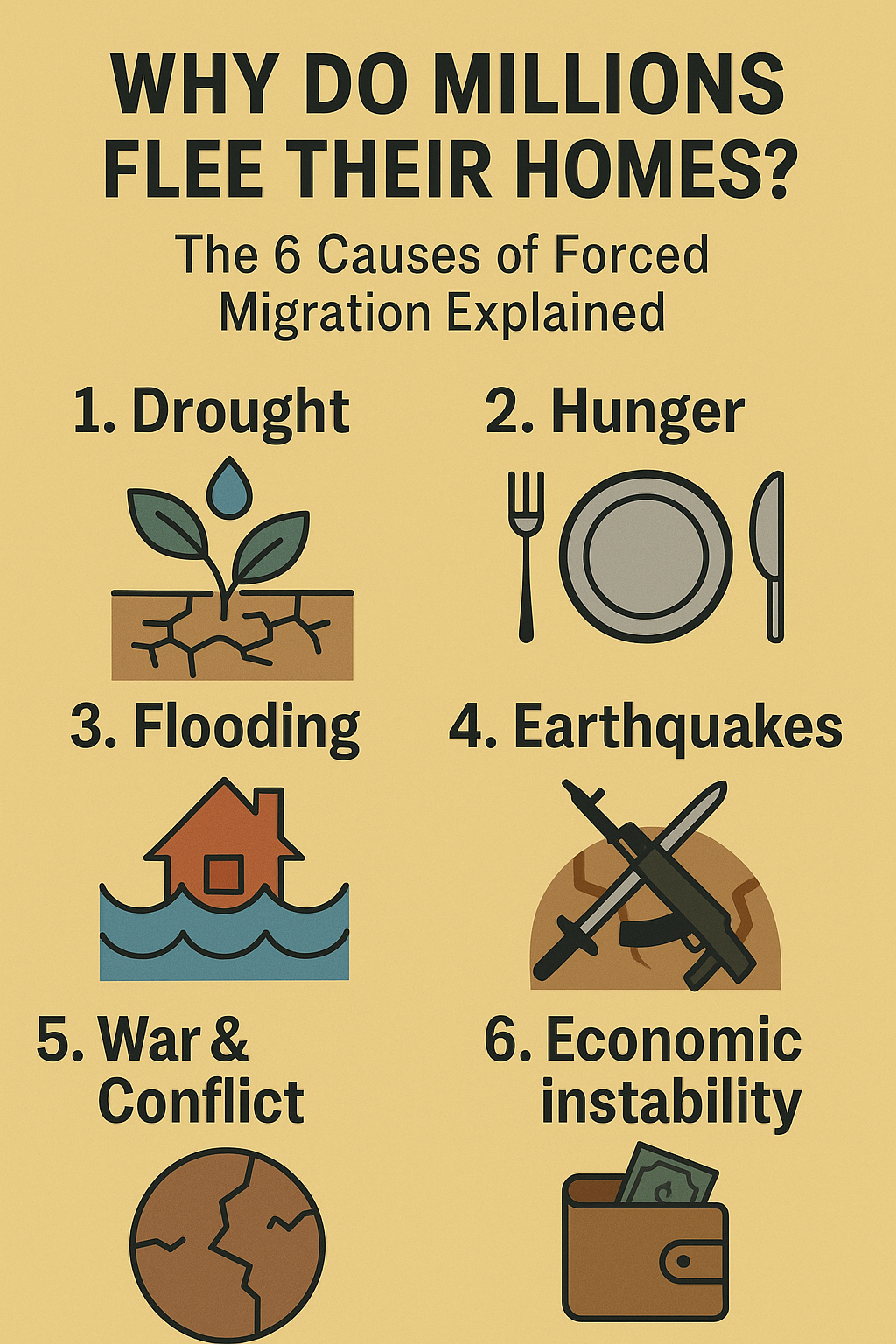

 1. Drought – Prolonged dry seasons destroy crops and leave communities without water, food, or income.
 2. Hunger – When harvests fail or food supplies are cut off due to conflict, families must migrate in search of survival.
 3. Flooding – Devastating floods can wipe out entire villages and force residents to flee for safety, often with no belongings left.
 4. Earthquakes – Sudden natural disasters, like the 2010 earthquake in Haiti or the 2015 Nepal quake, leave millions homeless.
 5. War & Conflict – The leading cause of forced migration. From Syria to South Sudan, violence drives families into exile.
 6. Economic instability – In places with high unemployment and rapid population growth, people migrate in search of opportunities to support their families.

 Share this post to spread awareness
 Connect with PROSDOMA to get involved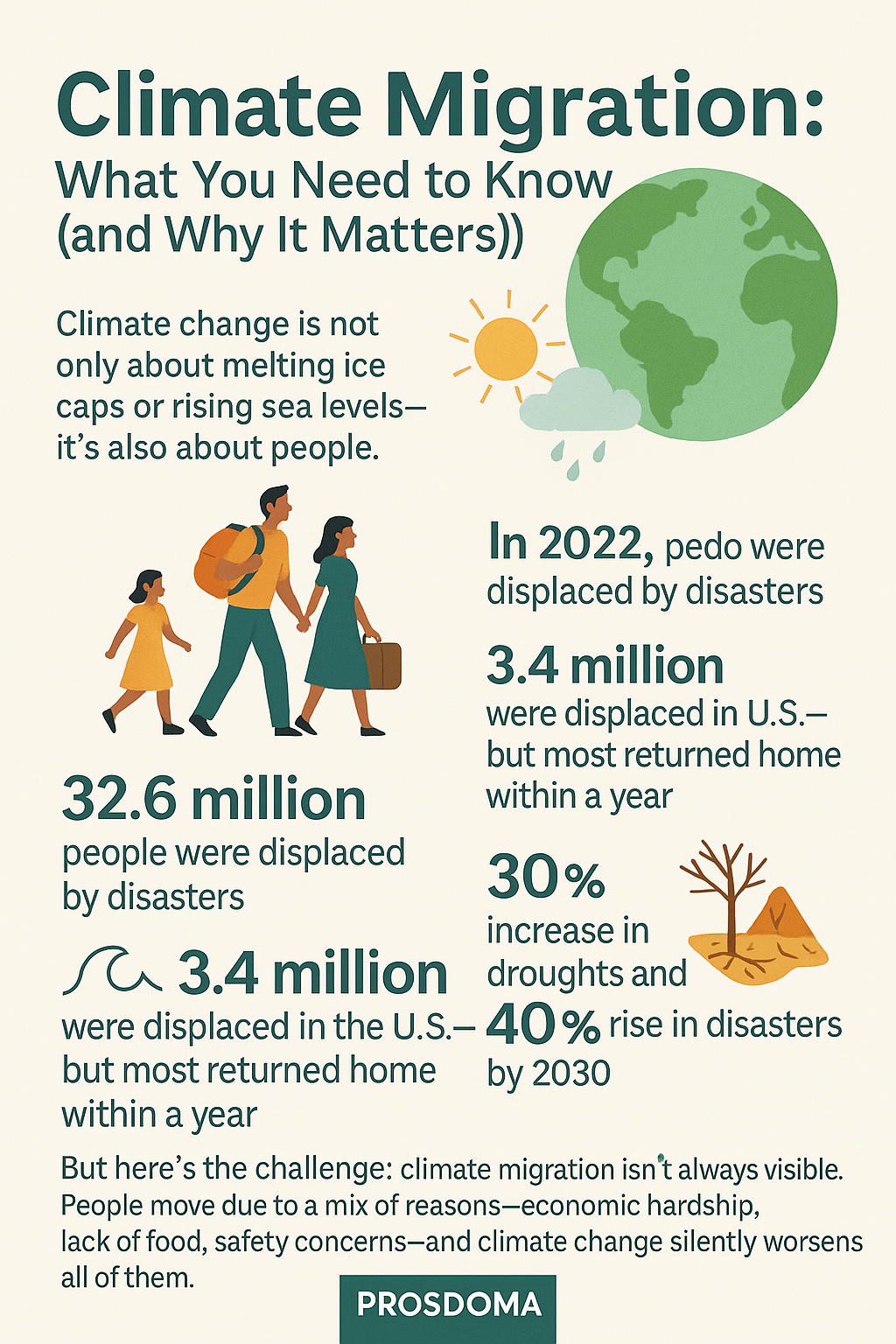
 In fact, in 2022 alone:
 and, when needed, support their safe relocation and integration into new communities—right here in Alberta and beyond.
 Join PROSDOMA in building a future where everyone has the right to a safe and sustainable home—no matter where they come from.
 Want to help or learn more? Follow us for more educational content and real-world impact.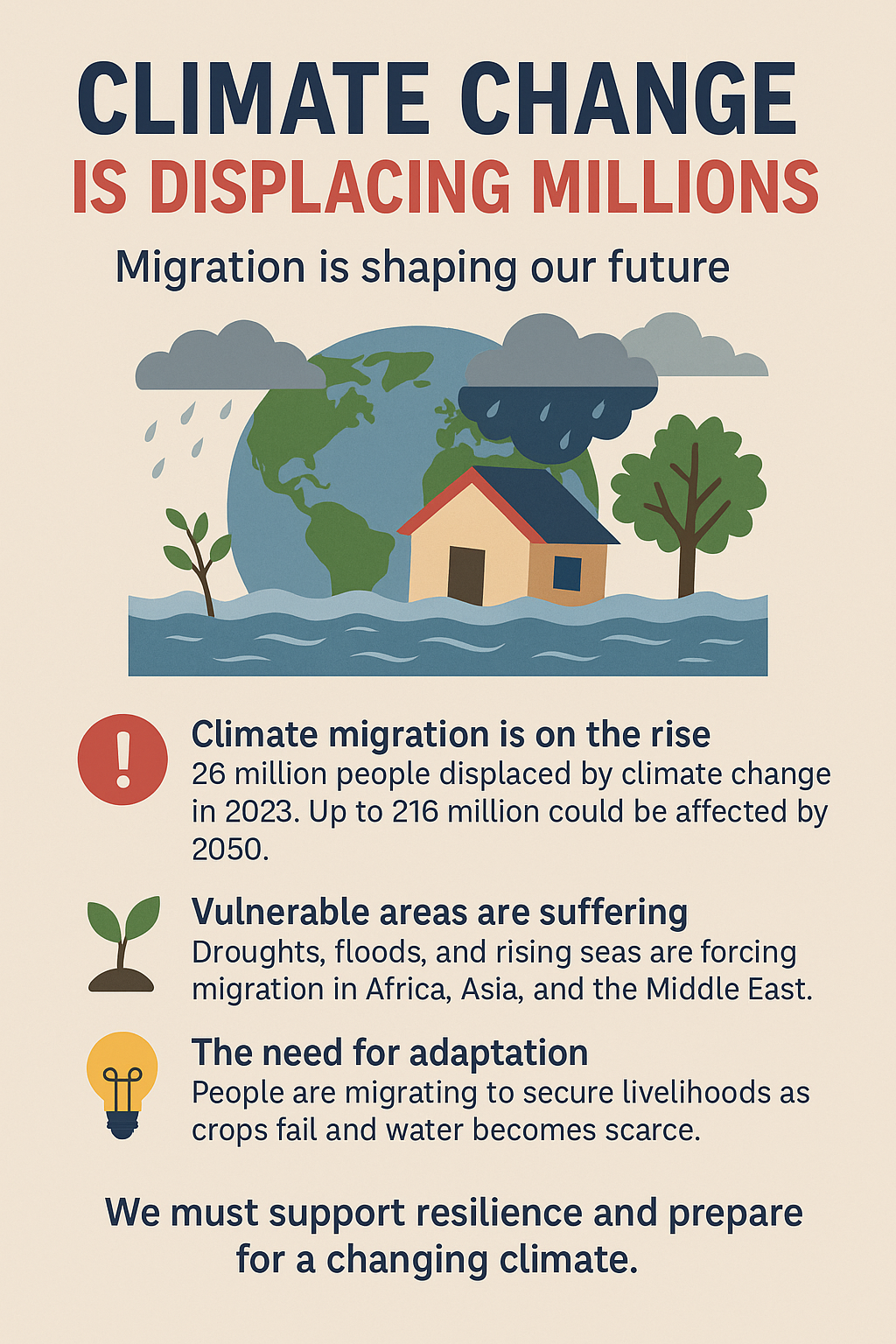
 Climate Migration is on the Rise: Extreme weather events are causing massive displacement. In 2023 alone, 26 million people were displaced by climate change. And by 2050, 216 million people could be affected globally.
 Prosdoma’s Commitment: At Prosdoma, we believe in fostering resilience. Through our programs, we assist newcomers by providing access to job search assistance, legal aid, and community support to help them successfully integrate. We also advocate for sustainable agricultural practices to address food security in communities affected by climate change.
 The climate migration crisis requires urgent action. We must advocate for climate resilience, support sustainable development, and ensure that vulnerable communities have the resources to adapt. Let’s stand together and build a more sustainable future for all.


 As global temperatures rise, vulnerable communities are facing a growing crisis – the need to migrate in search of safety and better livelihoods.
 What’s Being Done: Governments, NGOs, and international bodies like IOM are working on planned relocation, where entire communities are moved in an organized way to safer regions. But more support is needed to help these vulnerable groups adapt.
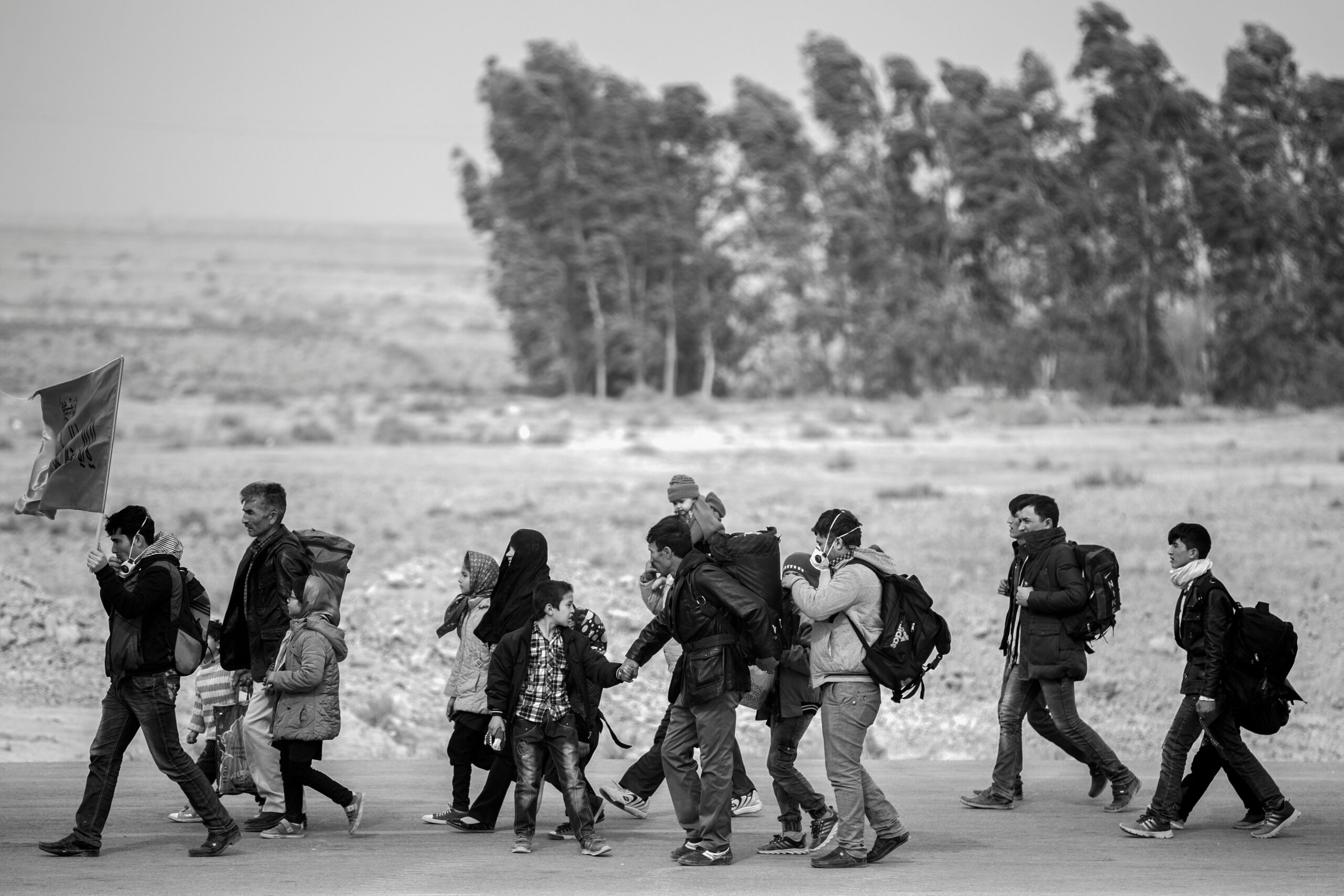
 But what does that really mean for communities, economies, and individuals?

 The Solution: We need better policies to support both the drivers of migration and the destination regions. This includes providing health services, infrastructure, and social support systems to help cities manage the growing influx of climate migrants.


 to shelters
  , volunteers are the unsung heroes who keep essential programs running.
 Volunteer Rates Are Dropping: Fewer people are giving their time, and that’s weakening our social safety net. This leads to: