Alors que la révolution numérique transforme des vies à travers le monde, des millions d’habitants des zones rurales d’Afrique restent déconnectés, non seulement d’Internet, mais aussi des opportunités. Et si la solution pour combler ce fossé résidait non seulement dans les câbles et les appareils à fibre optique, mais aussi dans des politiques et des pratiques TIC inclusives et adaptées au contexte ?
Dans leur étude novatrice, Joseph et Andrew (2006) affirment que les TIC peuvent catalyser le développement rural, à condition d’être conçues dans une optique d’autonomisation. Leur analyse d’études de cas en Afrique subsaharienne révèle comment l’accès aux outils numériques contribue à l’amélioration de l’agriculture, de la santé, de la gouvernance et de l’égalité des sexes.
✨ Parmi les réussites :
Internet en plein essor au Ghana : un pôle d’accès numérique et de développement des compétences.
Écoles en ligne du NEPAD : Offrent un accès gratuit à Internet, des points de santé et un apprentissage en ligne aux communautés défavorisées.
WOFAN (Nigeria) : Utiliser la radio pour éduquer les femmes rurales sur la santé, l’agriculture et leurs droits.
Voix des femmes (Kenya) : Apprendre aux femmes à créer des récits vidéo sur leur propre vie, à reprendre le pouvoir grâce à la narration.
Pourtant, les défis sont profondément enracinés :
Coûts élevés des appareils et de la connectivité
Populations rurales dispersées et faible niveau d’alphabétisation
Obstacles liés au genre dans l’accès aux TIC et au leadership
Absence de logiciels localisés et de conception centrée sur l’utilisateur
Des politiques TIC obsolètes qui n’incluent pas les populations les plus marginalisées
Alors, que pouvons-nous faire pour réduire la fracture numérique ?
Investir dans les infrastructures tout en subventionnant les outils TIC pour les ménages ruraux.
Traduire et adapter le contenu dans les langues locales pour en assurer la pertinence.
Autonomiser les femmes et les filles grâce à l’accès aux appareils, à la formation aux TIC et au leadership.
Promouvoir les pôles TIC communautaires et les projets de médias numériques menés par des femmes.
Chez PROSDOMA, nous savons que l’accès au numérique n’est pas qu’un problème technologique : c’est un enjeu de justice. C’est pourquoi notre travail s’étend sur plusieurs continents : nous soutenons les nouveaux arrivants au Canada et dynamisons les communautés en Afrique. Nous envisageons un avenir où aucune voix ne sera exclue du dialogue numérique.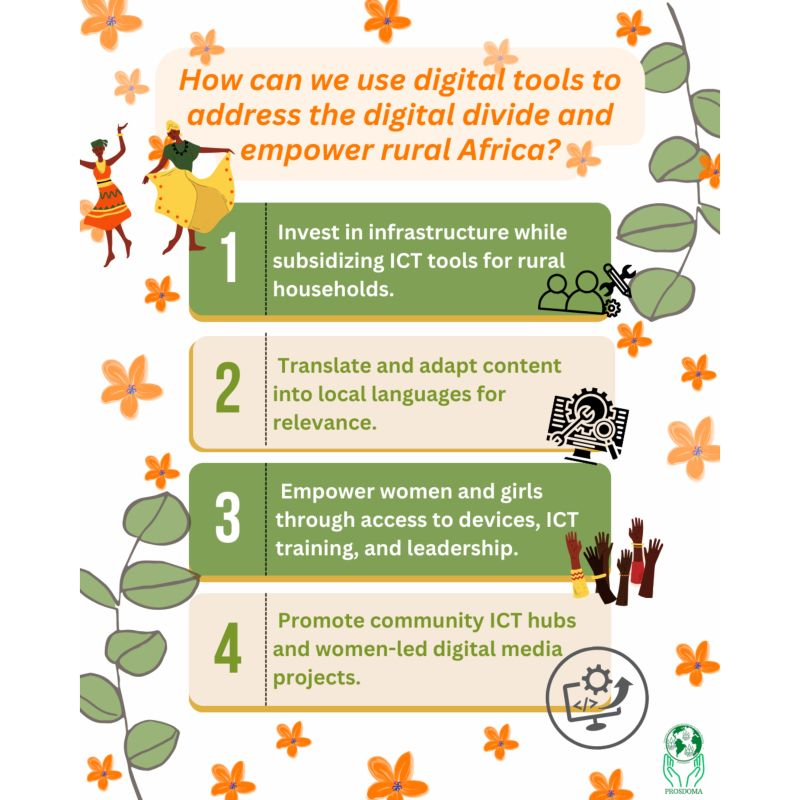
Rejoignez-nous : https://old.prosdoma.org/
par ED
Source : Joseph, M. et Andrew, T. (2006). Rêves ruraux africains : les TIC au service du développement. Actes de la conférence IST-Afrique.
Comment la technologie peut-elle favoriser des comportements durables ? Perspectives de la psychologie et du design
Saviez-vous que la technologie ne se contente pas de consommer des ressources, mais qu’elle peut aussi influencer la manière dont nous les préservons ?
Selon Midden et al. (2007), la technologie joue quatre rôles importants dans le comportement environnemental :
Intermédiaire – se situe entre le comportement et l’impact (par exemple, utiliser une ampoule plutôt que la lumière du soleil).
Amplificateur – améliore nos performances et notre utilisation des ressources (ex. : meilleures voitures = plus de conduite).
Déterminant – influence silencieusement les comportements en rendant certaines actions plus faciles ou plus difficiles (par exemple, la présence de pistes cyclables).
Promoteur – encourage le développement durable grâce à des retours interactifs, des systèmes intelligents et des médias immersifs.
Ces observations montrent que la conception comportementale et l’ingénierie doivent aller de pair pour construire un avenir plus vert.
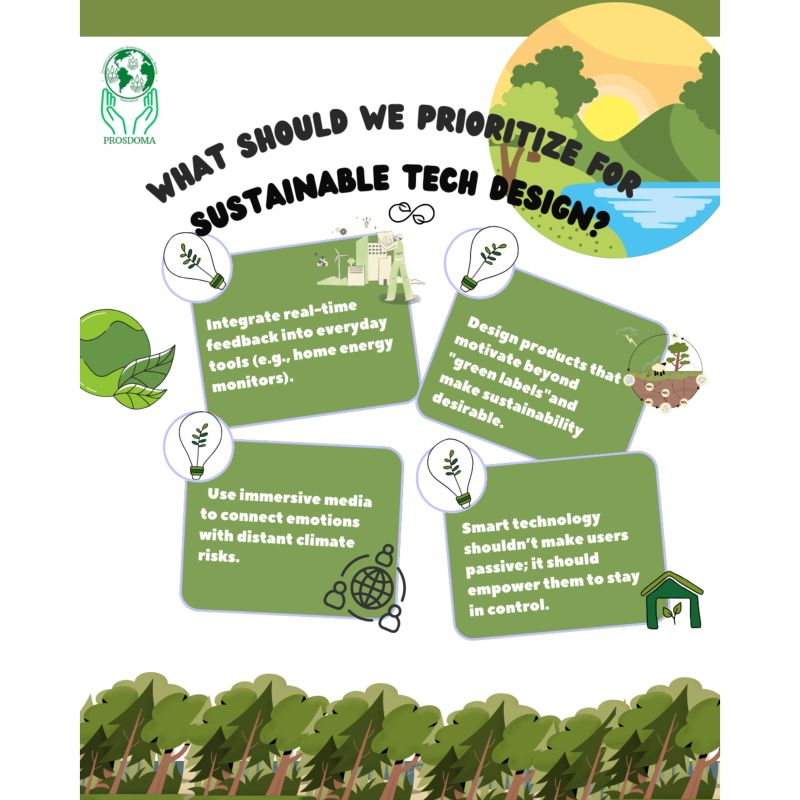
Quelles devraient être nos priorités en matière de conception technologique durable ?
Intégrez le retour d’information en temps réel dans les outils du quotidien (par exemple, les moniteurs de consommation d’énergie domestique).
Concevez des produits qui motivent au-delà des simples « labels écologiques » — rendez la durabilité désirable.
Utiliser les médias immersifs pour relier les émotions aux risques climatiques lointains.
Les technologies intelligentes ne doivent pas rendre les utilisateurs passifs ; elles doivent leur donner les moyens de garder le contrôle.
Chez PROSDOMA, nous croyons que le développement durable commence par la prise de conscience et se concrétise par l’action. Qu’il s’agisse de soutenir l’agriculture rurale en Afrique ou l’alphabétisation numérique au Canada, nous reconnaissons le rôle transformateur de la technologie dans la préservation des ressources.
Rejoignez-nous : https://old.prosdoma.org/
par ED
Source : Midden, CJH, Kaiser, FG, & McCalley, LT (2007). Les quatre rôles de la technologie dans la compréhension de la conservation des ressources naturelles par les individus, Journal of Social Issues.
⚖️ Le plaidoyer juridique peut-il garantir la justice climatique ? Explorer le pouvoir du droit face aux inégalités
À mesure que le changement climatique s’accélère, les injustices qu’il engendre s’aggravent. Bien que contribuant le moins aux émissions mondiales, les communautés marginalisées, des quartiers défavorisés des États-Unis aux villages côtiers du Bangladesh, subissent de plein fouet les catastrophes environnementales, la pollution toxique et les migrations forcées.
Selon Ahmed et Uddin (2025), le plaidoyer juridique est devenu un outil essentiel dans la lutte pour la justice environnementale. En examinant des affaires emblématiques telles que Juliana c. États-Unis, Urgenda c. Pays-Bas et Waorani c. Équateur, les auteurs démontrent comment les tribunaux peuvent responsabiliser les gouvernements et les entreprises, faire respecter les objectifs d’émissions et donner aux communautés locales les moyens de protéger leurs terres et leur santé.
Cependant, d’importantes lacunes subsistent :
La Convention de 1951 relative au statut des réfugiés ne reconnaît pas les déplacements de population liés au changement climatique.
De nombreuses lois environnementales manquent de pouvoir coercitif.
L’accès à l’aide juridique reste limité pour les populations vulnérables.
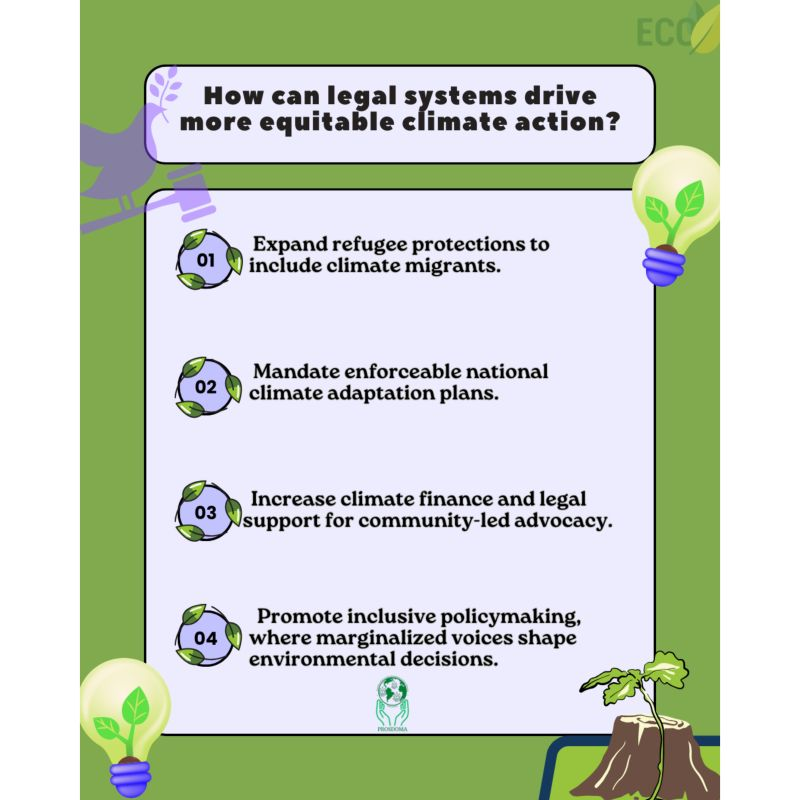
Alors, comment les systèmes juridiques peuvent-ils favoriser une action climatique plus équitable ?
Étendre la protection des réfugiés aux migrants climatiques.
Imposer des plans nationaux d’adaptation au changement climatique exécutoires.
Accroître le financement climatique et le soutien juridique aux actions de plaidoyer menées par les communautés.
Promouvoir l’élaboration de politiques inclusives, où les voix marginalisées contribuent à façonner les décisions environnementales.
Chez PROSDOMA, nous croyons que justice et durabilité sont indissociables. Qu’il s’agisse de défendre les moyens de subsistance ruraux en Afrique ou de soutenir les migrants au Canada, nous militons pour un monde où le droit sert équitablement la planète et ses habitants.
Rejoignez-nous : https://old.prosdoma.org/
par ED
Source:
Ahmed, M. & Uddin, MJ (2025). Justice environnementale et rôle du plaidoyer juridique dans la lutte contre le changement climatique. Journal of Humanities and Social Sciences Studies, 7(4), 45–64. https://lnkd.in/dBv3kzge
L’éducation peut-elle sauver l’environnement ? Un nouveau regard sur les stratégies efficaces en matière de conservation.
D’après une revue systématique rigoureuse menée par Ardoin et al. (2020), l’éducation à l’environnement (EE), lorsqu’elle est conçue de manière ciblée, peut faire bien plus que sensibiliser. Elle peut engendrer des résultats concrets en matière de conservation.
Dans une analyse de 105 études, des chercheurs ont constaté que si la plupart des programmes d’éducation à l’environnement améliorent les connaissances et les attitudes, un nombre croissant d’entre eux entraînent également :
Changement de comportement observé (par exemple, réduction de la consommation d’eau/de pesticides)
Actions environnementales (par exemple, reboisement, efforts de nettoyage)
Renforcement des capacités communautaires (par exemple, les groupes locaux de conservation)
Améliorations écologiques (par exemple, la qualité de l’eau, les gains de biodiversité)
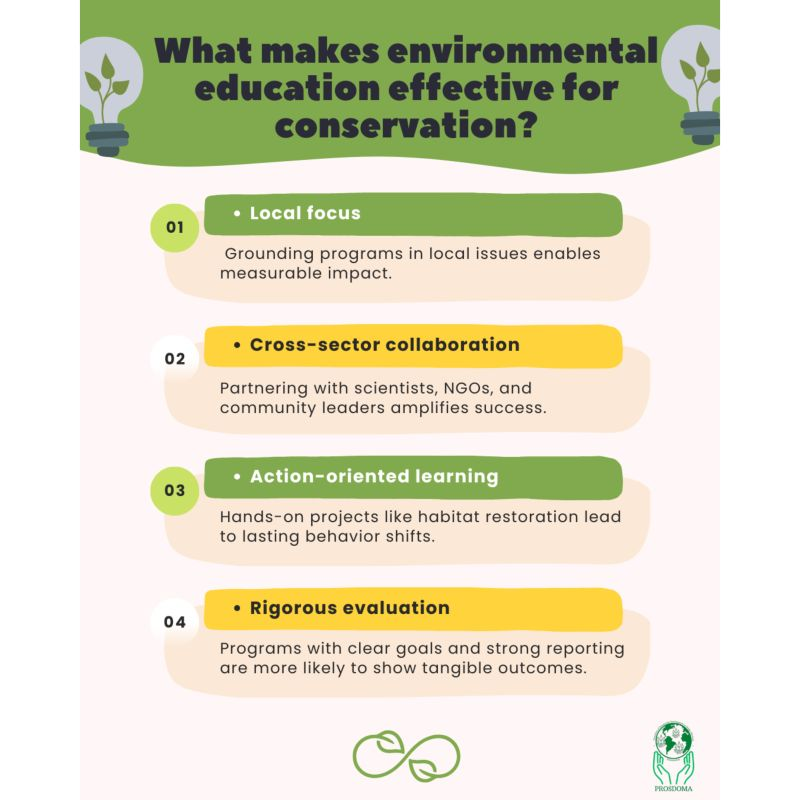
Alors, qu’est-ce qui rend l’éducation environnementale efficace pour la conservation ?
Priorité locale :
Ancrer les programmes dans les problématiques locales permet d’obtenir un impact mesurable.
Collaboration intersectorielle :
Le partenariat avec les scientifiques, les ONG et les leaders communautaires amplifie le succès.
Apprentissage axé sur l’action :
Les projets concrets comme la restauration des habitats entraînent des changements de comportement durables.
Évaluation rigoureuse :
Les programmes dotés d’objectifs clairs et d’un système de rapports rigoureux sont plus susceptibles de produire des résultats tangibles.
Chez PROSDOMA, nous croyons que l’éducation environnementale est un catalyseur de transformation sociale et écologique. Qu’il s’agisse d’autonomiser les communautés rurales en Afrique ou les nouveaux arrivants au Canada, notre travail relie le savoir à l’action, veillant à ce que l’éducation ne se limite pas à la sensibilisation, mais devienne un outil de changement concret.
Rejoignez-nous : https://old.prosdoma.org/
par ED
Source:
Ardoin, NM et al. (2020). Résultats de l’éducation environnementale pour la conservation : une revue systématique. Biological Conservation, 241, 108224
Pourquoi le développement rural est l’épine dorsale de l’avenir agricole de l’Afrique
En Afrique, 70 % de la population active travaille dans l’agriculture, pourtant de nombreuses communautés rurales restent sous-développées et mal desservies.
L’agriculture est la principale source de revenus pour 90 % de la population rurale — et pourtant, ces régions manquent souvent d’infrastructures, de financements et d’outils modernes.
La négligence de l’agriculture a entraîné un exode massif des zones rurales vers les zones urbaines, laissant les villages dépeuplés et peu attractifs pour les investissements.
Le développement rural durable ne se limite pas à l’agriculture ; il englobe la santé, l’éducation, les routes, l’accès à l’énergie, l’autonomisation des femmes et le leadership communautaire.
Un modèle intégré de développement rural — associant l’agriculture aux infrastructures, à l’éducation et à la santé — est essentiel à la résilience à long terme.
Alors, que faut-il faire pour l’avenir de l’agriculture en Afrique ?
Investir dans les infrastructures rurales (routes, eau, électricité) pour améliorer l’accessibilité et réduire l’exode rural.
Soutenir les petits exploitants agricoles en leur donnant accès à la terre, au financement et à la formation aux techniques modernes et durables.
Renforcer les institutions et coopératives locales pour gérer les ressources, réduire les inégalités et accroître la résilience.
Mettre en œuvre des approches de développement rural intégrées qui combinent agriculture, santé, éducation et accès numérique.
C’est pourquoi des organisations comme PROSDOMA sont importantes. Leur engagement envers l’intégration des nouveaux arrivants au Canada et l’agriculture durable en Afrique en fait un lien entre les communautés mondiales et la résilience locale.
Rejoignez-nous : https://old.prosdoma.org/
par ED
Source:
Nchuchuwe, FF et Adejuwon, KD (2012). Les défis de l’agriculture et du développement rural en Afrique : le cas du Nigéria. Revue internationale de recherche académique en éducation et développement progressistes.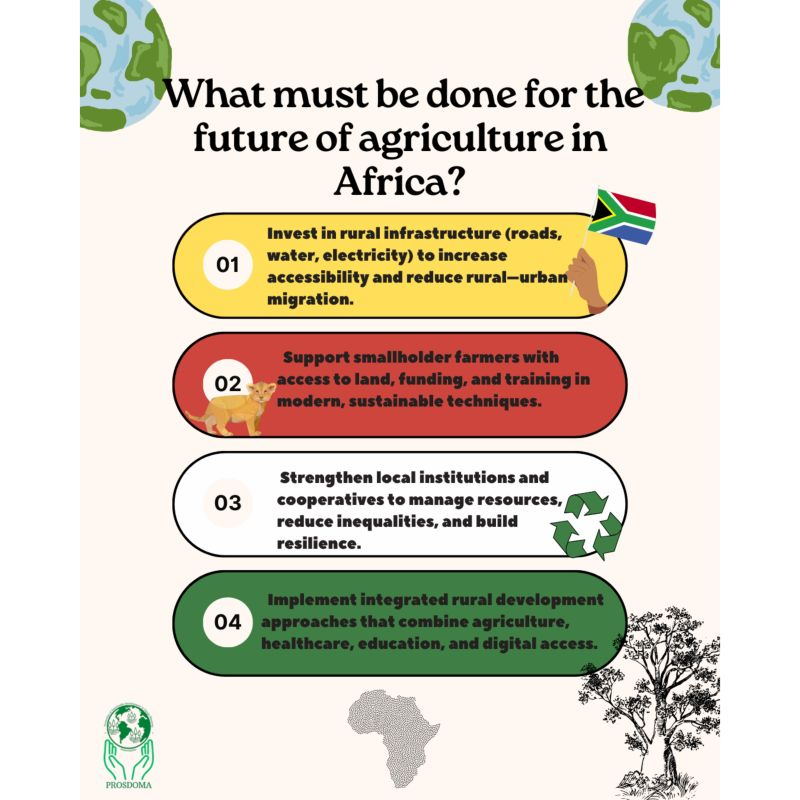

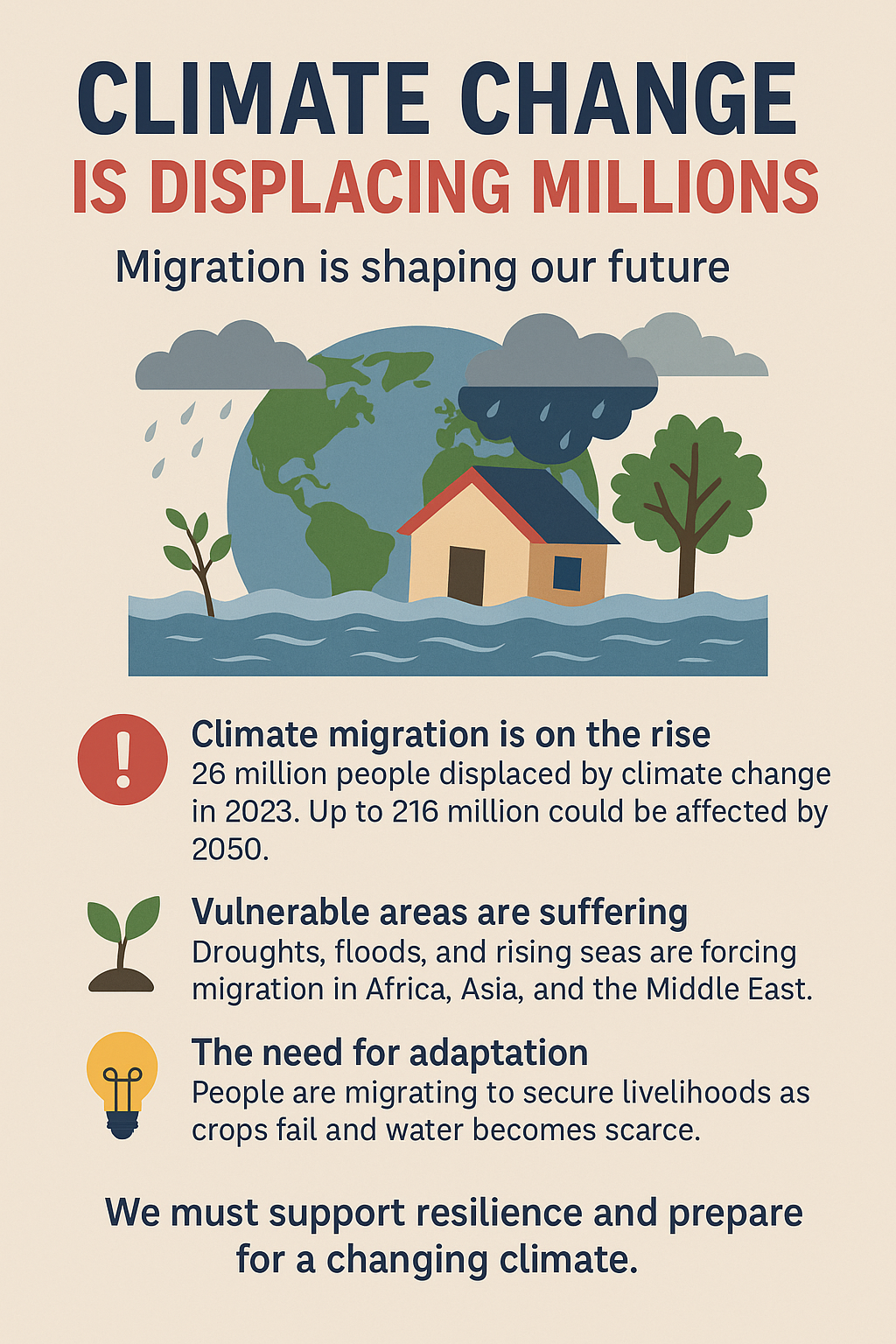
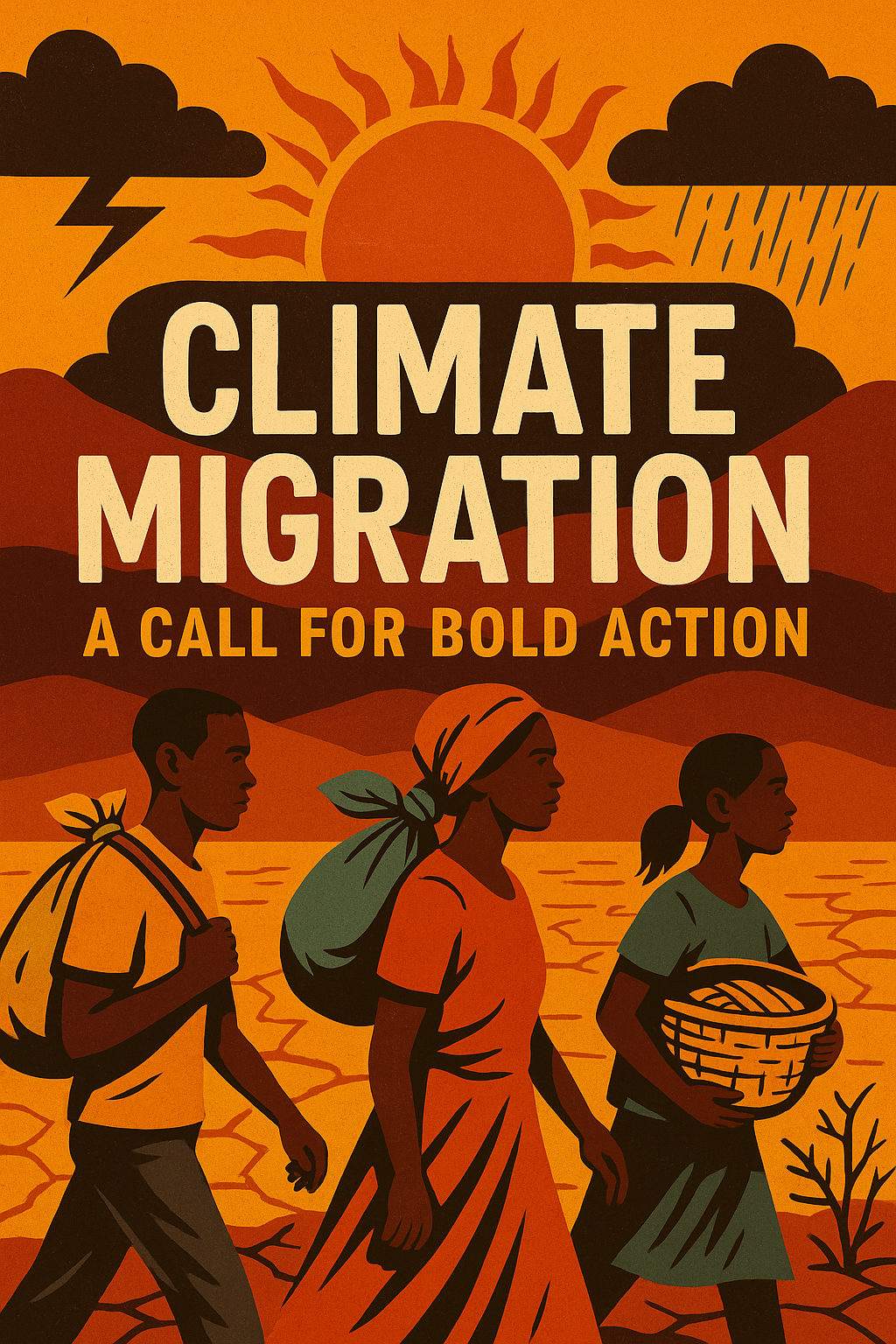
 Des sécheresses aux inondations, les gens sont contraints de quitter leurs foyers en quête de sécurité et de stabilité.
 Les migrations climatiques s’intensifient : les phénomènes météorologiques extrêmes provoquent des déplacements massifs de population. Rien qu’en 2023, 26 millions de personnes ont été déplacées par le changement climatique. Et d’ici 2050, ce chiffre pourrait atteindre 216 millions à l’échelle mondiale.
 Les zones vulnérables souffrent : des pays d’Afrique, d’Asie et du Moyen-Orient sont confrontés à de graves défis climatiques. Du stress hydrique en Afrique subsaharienne à la montée des eaux dans les régions de faible altitude, ces zones deviennent de plus en plus inhabitables, forçant les populations à migrer.
 L’impératif d’adaptation : les migrations ne sont pas seulement une réponse aux catastrophes ; elles visent aussi à assurer la survie des populations. Celles-ci quittent des zones agricoles où les cultures ne poussent plus ou où le bétail ne peut survivre. Il est essentiel de soutenir les relocalisations planifiées et de veiller à ce que des ressources soient disponibles pour aider ces migrants à s’intégrer et à s’adapter.
 L’engagement de Prosdoma : Chez Prosdoma, nous croyons au renforcement de la résilience. Grâce à nos programmes, nous aidons les nouveaux arrivants en leur donnant accès à une aide à la recherche d’emploi, à une assistance juridique et à un soutien communautaire pour faciliter leur intégration. Nous préconisons également des pratiques agricoles durables pour garantir la sécurité alimentaire dans les communautés touchées par les changements climatiques.
 La crise des migrations climatiques exige une action urgente. Nous devons plaider en faveur de la résilience climatique, soutenir le développement durable et veiller à ce que les communautés vulnérables disposent des ressources nécessaires pour s’adapter. Unissons nos efforts pour bâtir un avenir plus durable pour tous.

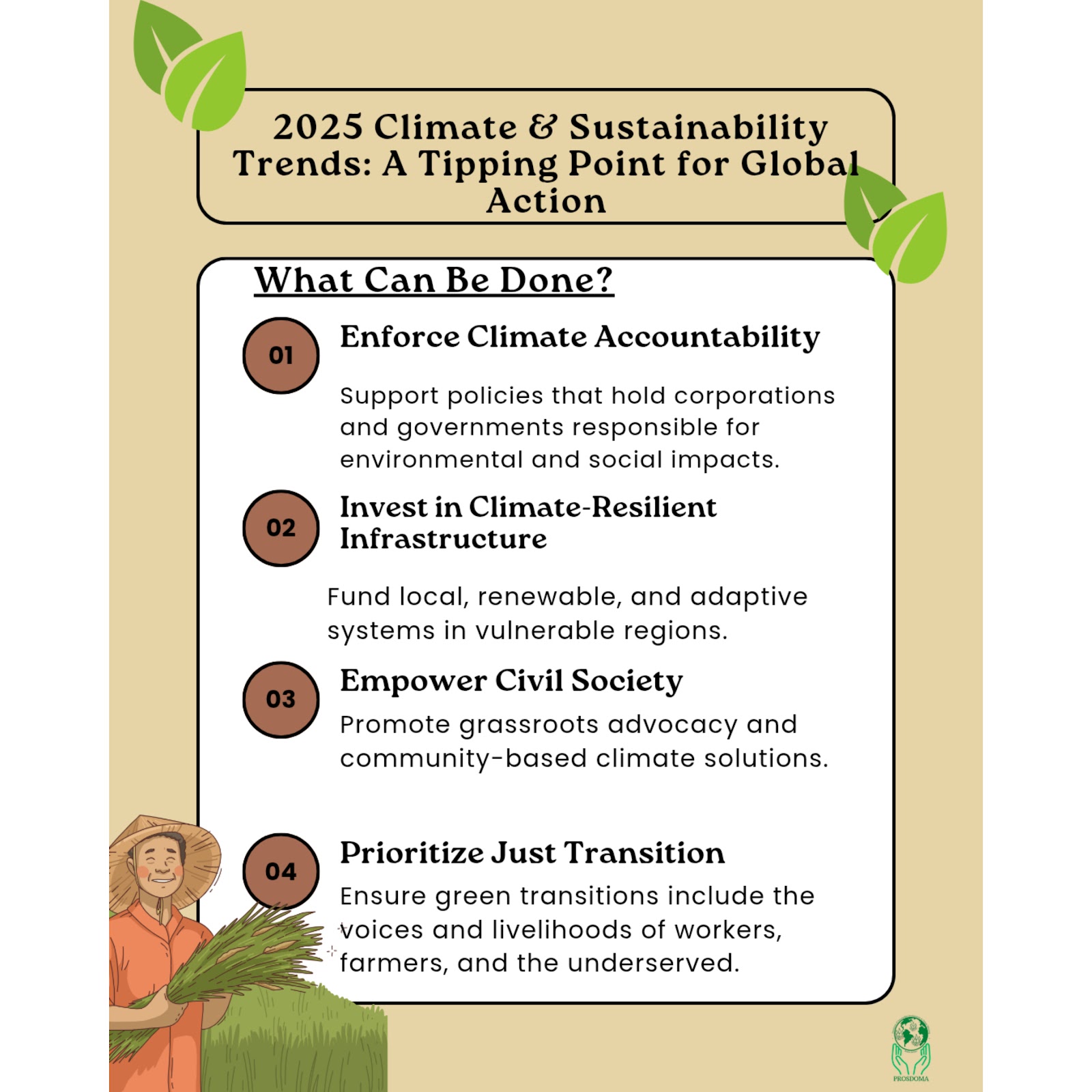
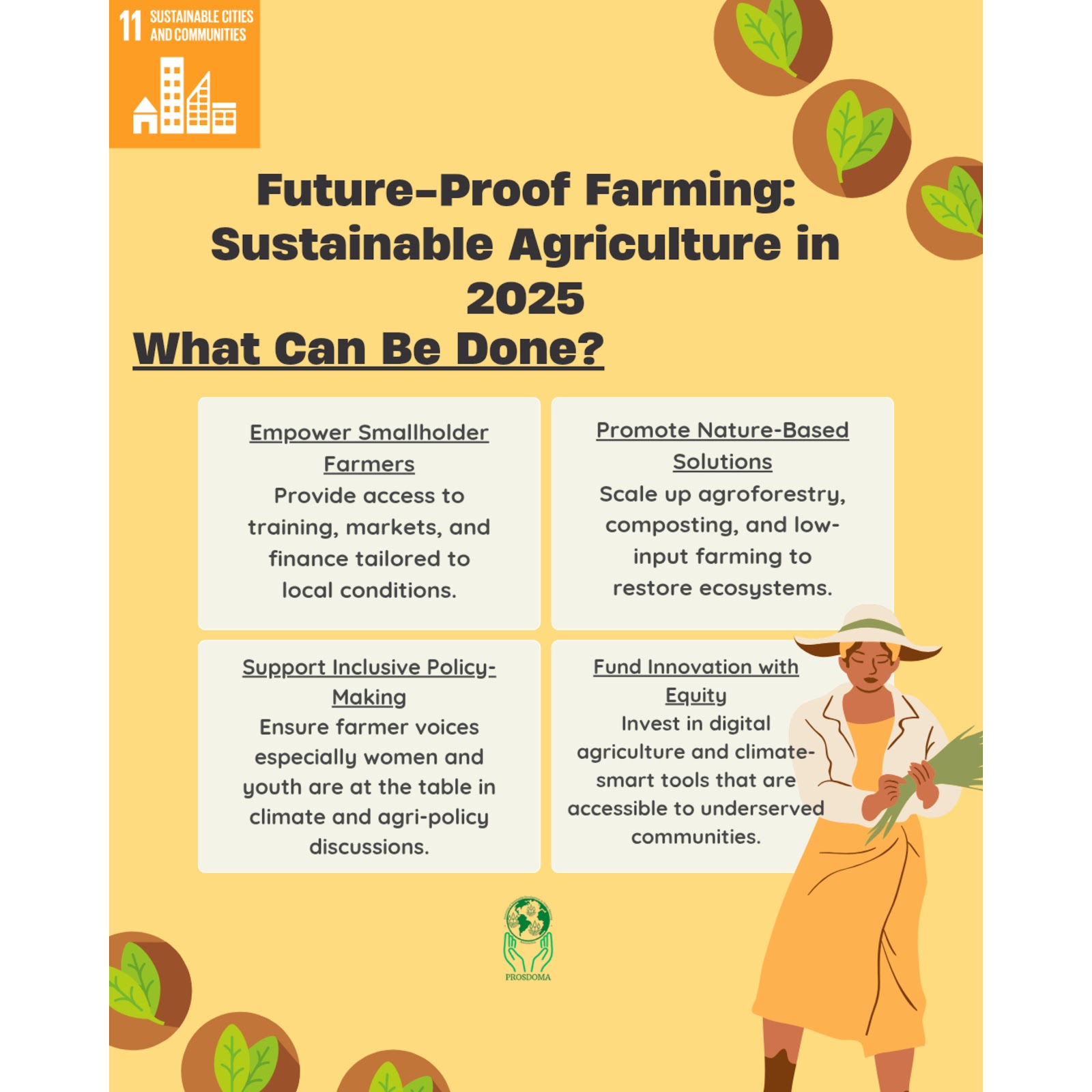
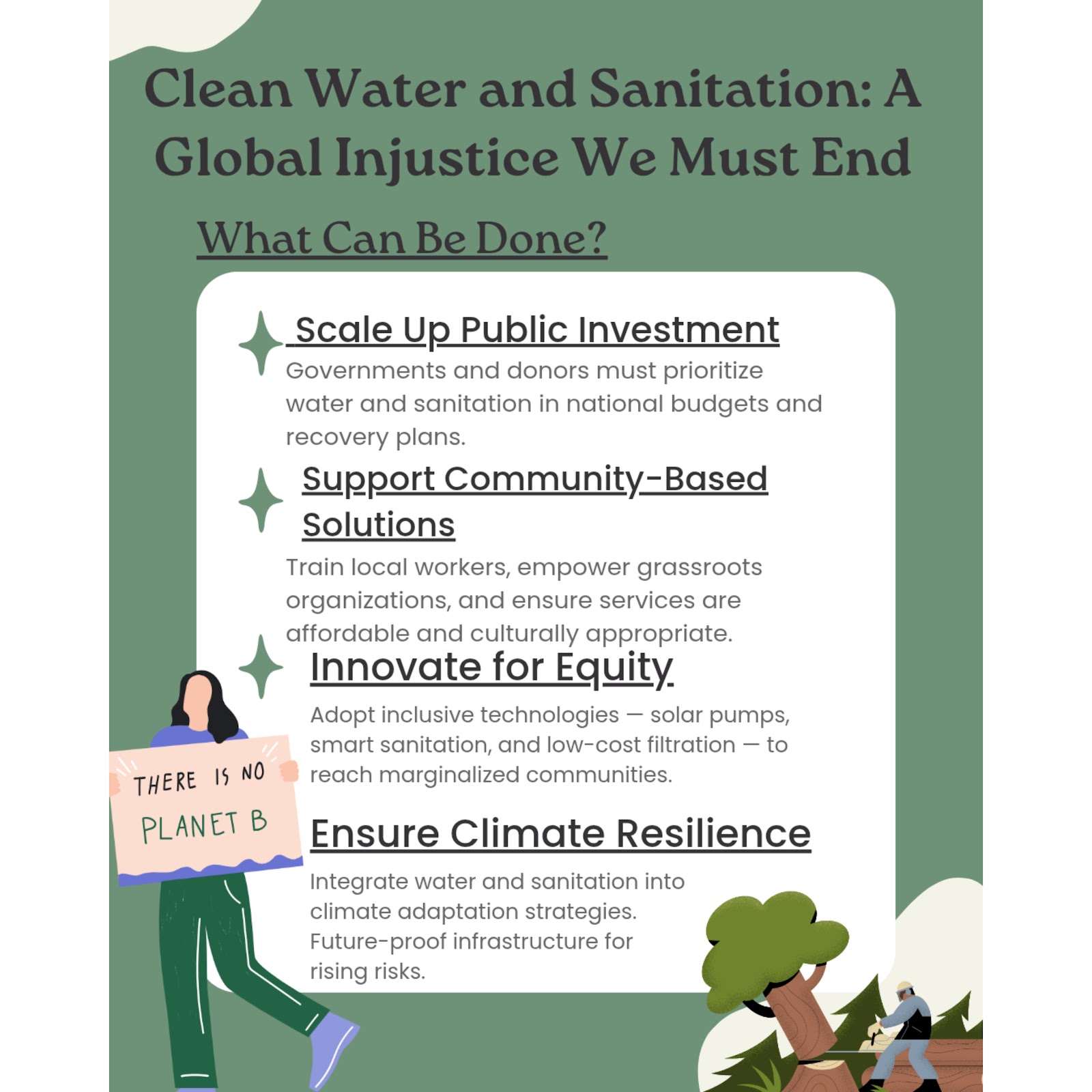

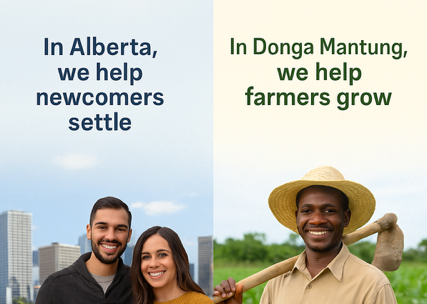


 Dans le nord du Nigéria, le passage de la transformation de la viande au bois de chauffage à l’énergie solaire a créé des emplois, freiné la déforestation et même ramené des jeunes des villes..

 , sensibiliser au changement climatique en Alberta
  et en aidant les nouveaux arrivants à s’épanouir grâce à des formations professionnelles, un soutien à la sécurité alimentaire et des programmes écoresponsables.