Starting life in a new country can feel overwhelming—but it doesn’t have to be. That’s where settlement agencies come in!
These organizations, often supported by government funding, offer free or low-cost services to help newcomers like you:
Navigate job searches Access housing resources Understand the healthcare and education systems Evaluate foreign credentials Learn about career licensing and bridging programs Connect with others in your community
As Ruth Demeke, a newcomer turned community leader, shares: “Settlement agencies were vital to my success.” She now delivers info sessions at the same places that helped her family 30 years ago!
Whether you’re new to Alberta or arriving from halfway across the world, these agencies are your lifeline to smoother integration, better opportunities, and a real sense of belonging.
At PROSDOMA, we’re proud to be part of this network of support—linking newcomers to everything from job search help to food banks, basic computer training, and immigration aid. And we do more than that! We also promote climate action and sustainable agriculture in Africa.
Don’t navigate your new life alone. Reach out to your local settlement agency—or connect with PROSDOMA today and let’s build your future together.
Canada is welcoming more newcomers than ever, but how can we go beyond just helping and truly empowering them?
Four inspiring nonprofit leaders are showing the way:
Empowerment, not charity Joanne Owuor of the Uzima Network reminds us that newcomers bring rich experiences. Real support means recognizing their strengths, not just their needs.
Wraparound care works At Calgary’s Centre for Newcomers, Shamaila Akram implements holistic case management—addressing housing, mental health, food, employment, and culture, all at once.
Preserve dignity through innovation Suman Roy’s Feed Scarborough uses a points-based grocery system so families can choose their food with dignity—especially important for immigrants dealing with food insecurity.
Women at the table Uzma Bhutto’s Coalition of Muslim Women helps racialized women become leaders, entrepreneurs, and advocates—proving that community change starts with empowered women.
At PROSDOMA, we echo these values every day—from connecting newcomers in Alberta to food banks and housing, to providing computer training and supporting African farmers
Let’s learn from these changemakers and work together to build stronger, more inclusive communities
Want to support newcomer integration in Alberta or Cameroon? Get involved with PROSDOMA today!
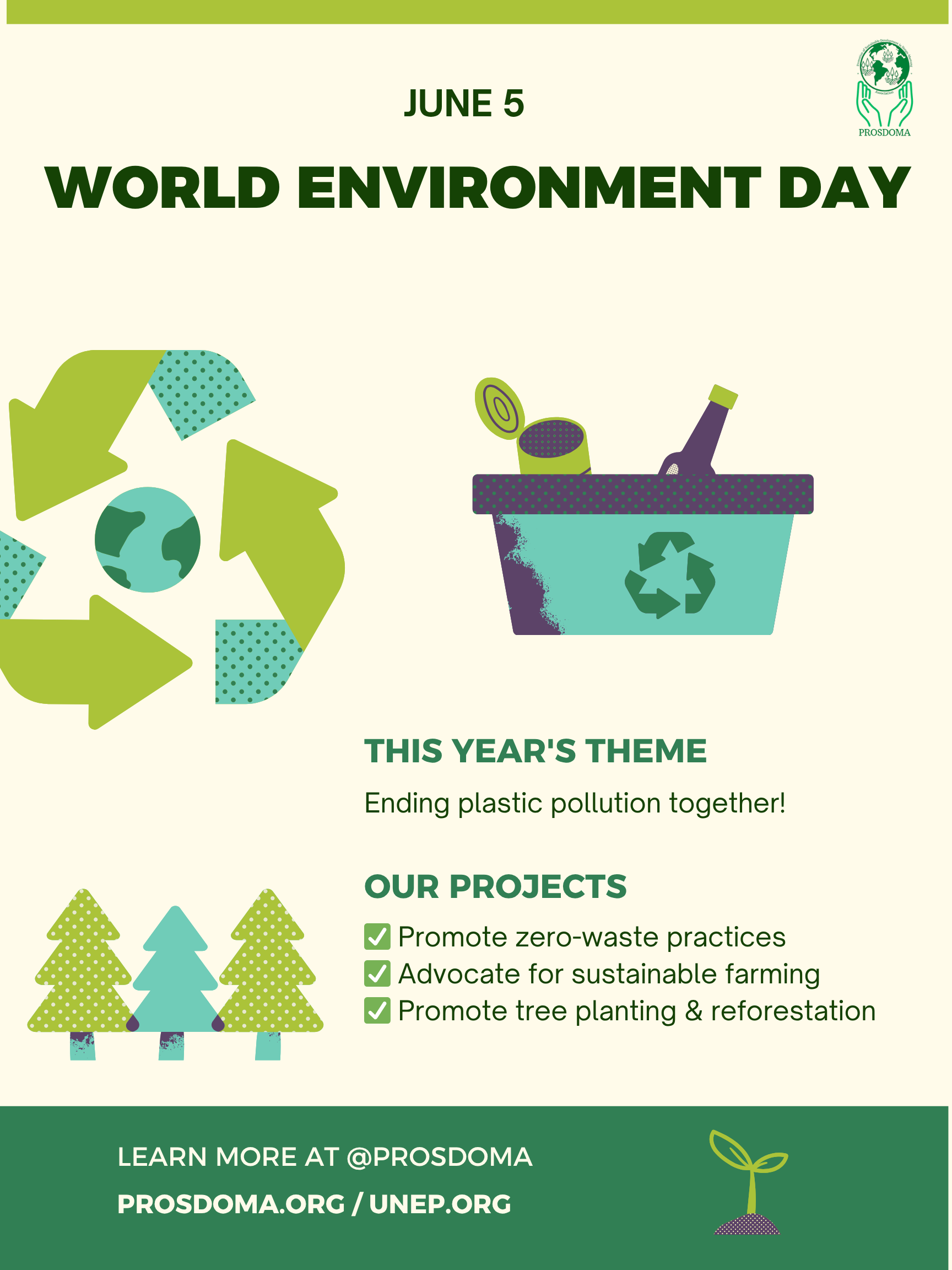
Since 1973, this United Nations-led day has united over 150 countries to raise awareness and take bold action for the planet. This year’s theme? Ending plastic pollution — a crisis we can no longer ignore.
Every year, the world produces more than 430 million tonnes of plastic, two-thirds of which become waste. These plastics pollute our oceans, harm wildlife, and even enter our food chain. That’s why countries like South Korea are taking the lead to push for a global plastic treaty — and so are we.
At PROSDOMA, we believe that environmental justice starts at the community level. That’s why we: Support sustainable food systems Promote zero-waste practices Host tree-planting & reforestation projects Educate and advocate on climate-friendly policies Support newcomers in building eco-conscious communities
Whether you plant a tree, reduce single-use plastics, or share knowledge — your actions matter.
This World Environment Day, join the movement toward a cleaner, greener future. Learn more & get involved: prosdoma.org Source: worldenvironmentday.global #WorldEnvironmentDay #PlasticPollution #ClimateAction #Sustainability #PROSDOMA SH
Every 2 seconds, one person in the world is forced to flee their home — that’s over 68.5 million people globally. But what drives these urgent and heartbreaking decisions?
Here are the 6 major causes of forced migration — where people are displaced against their will, whether within their own country or across borders:
1. Drought – Prolonged dry seasons destroy crops and leave communities without water, food, or income.
2. Hunger – When harvests fail or food supplies are cut off due to conflict, families must migrate in search of survival.
3. Flooding – Devastating floods can wipe out entire villages and force residents to flee for safety, often with no belongings left.
4. Earthquakes – Sudden natural disasters, like the 2010 earthquake in Haiti or the 2015 Nepal quake, leave millions homeless.
5. War & Conflict – The leading cause of forced migration. From Syria to South Sudan, violence drives families into exile.
6. Economic instability – In places with high unemployment and rapid population growth, people migrate in search of opportunities to support their families.
At PROSDOMA, we work directly with newcomers in Alberta who have faced many of these challenges. From offering essential settlement services to raising awareness of climate and conflict-driven migration, we are here to help build resilience and hope. Together, we can support those seeking safety, dignity, and a better life
Migration is more than movement — it’s a story of survival, dreams, and the pursuit of a better future.
Across the globe, millions of people migrate every year. But why do they leave everything behind? The answer lies in four major root causes — push and pull factors that shape lives and destinies:
Safety Factors: Many flee their homes due to war, persecution, or organized violence. In regions like the Northern Triangle (Guatemala, Honduras, El Salvador), gang violence and lawlessness force families to seek safer ground.
Economic Factors: Poverty, unemployment, and lack of opportunity drive people to migrate to areas with higher wages and job availability. As economies improve or decline, so do migration patterns — as seen in Mexican migration trends to the U.S.
Environmental Factors: Natural disasters, pollution, and climate change displace millions. From Haiti’s devastating earthquake to prolonged droughts in Syria, environmental crises fuel migration, often leaving communities vulnerable and unsupported.
Social Factors: Education, healthcare, and better living standards motivate people to move. Migrants want to build a better life for their children, access life-saving treatment, or pursue career growth.
At PROSDOMA, we see the people behind these statistics. We support newcomers in Alberta with essential services like legal aid, job assistance, and access to shelters. Let’s continue building a world where no one is left behind — whether in Canada or across the globe.
Want to support or learn more about how PROSDOMA is helping migrants and refugees? Reach out today!
Several Alberta communities were forced to evacuate as wildfires continue to rage across the province. These fires not only pose immediate danger to people and wildlife—they also threaten the long-term sustainability of Alberta’s forests.
Forests take decades to recover, and reforestation is essential—but it’s not quick or easy. That’s why PROSDOMA is committed to helping restore Alberta’s natural landscapes, one tree at a time.
Through our tree planting efforts, we’re supporting reforestation and long-term forest health in wildfire-affected regions.
You can help too. Support our work and join the movement toward a more resilient, greener Alberta.
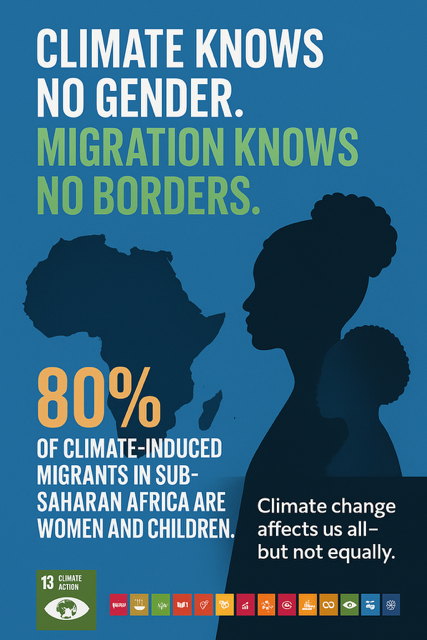
Did you know that climate change is becoming one of the biggest drivers of migration around the world?
<.png> Rising temperatures
<.png> Sea-level rise
<.png> Extreme weather events like hurricanes, droughts, and floods
<.png> Crop failures and water shortages
These climate-related pressures are forcing millions to leave their homes, not by choice, but out of necessity. From small island nations sinking under rising seas to farmers in drought-stricken regions losing their livelihoods, people are on the move looking for safety and stability.
This isn’t just a future problem. It’s happening now.
Climate justice = human rights.
Migration should be a choice, not a survival strategy.
Across Sub-Saharan Africa, a quiet revolution is growing. From Kenya to Ghana, smallholder farmers are embracing Artificial Intelligence (AI) to tackle food insecurity, climate shocks, and resource inefficiencies. Once a futuristic vision, AI is now transforming how crops are grown, monitored, and harvested.
AI adoption in agriculture is booming, global investments are expected to rise from $1.7B in 2023 to $4.7B by 2028. In Africa, agri-tech funding skyrocketed from under $10M in 2014 to $600M by 2022. This shift is enabling farmers to use drones, sensors, predictive analytics, and computer vision to optimize irrigation, detect pests, and reduce crop loss.
Projects like Hello Tractor connect farmers with smart equipment via mobile apps, while platforms like the Kenya Agricultural Observatory provide real-time weather and planting data. Yet challenges persist: digital divides, lack of training, high costs, and concerns about data ethics.
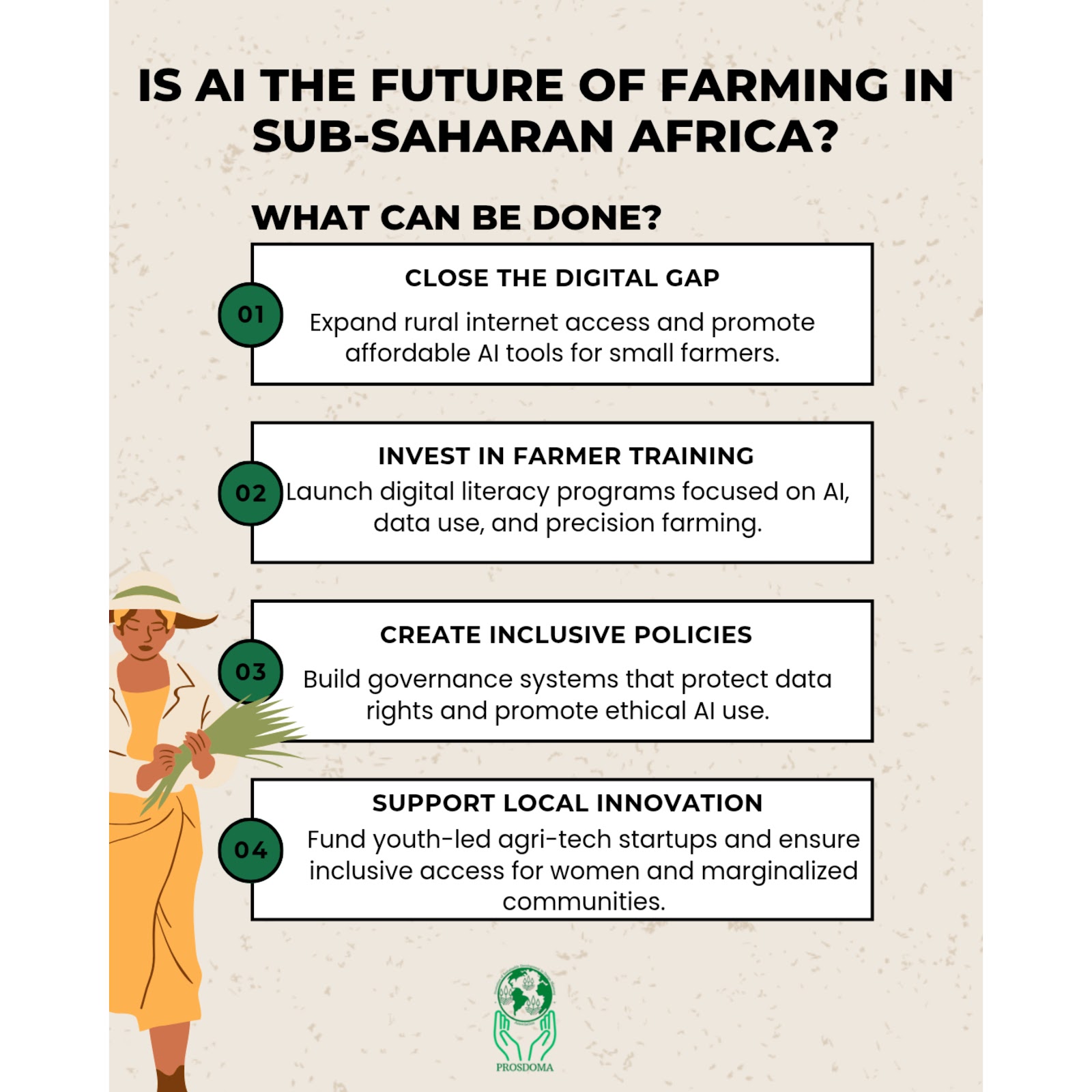
✅ What Can Be Done?
1️⃣ Close the Digital Gap
Expand rural internet access and promote affordable AI tools for small farmers.
2️⃣ Invest in Farmer Training
Launch digital literacy programs focused on AI, data use, and precision farming.
3️⃣ Create Inclusive Policies
Build governance systems that protect data rights and promote ethical AI use.
4️⃣ Support Local Innovation
Fund youth-led agri-tech startups and ensure inclusive access for women and marginalized communities.
AI can unlock a food-secure, tech-driven future but only if we ensure equitable access and strong policy backing.
Source: World Bank Blogs, “Is Artificial Intelligence the Future of Farming?, 2025.#FoodSecurity #AIforFarming #SmartAgriculture #DigitalInclusion #Prosdoma #AfricaInnovation #ClimateAction #AgriTech
AI and the Future of Water Management: Smarter, Safer, More Resilient.
Water management is now at the center of the global sustainability conversation. With climate change, urban expansion, and poor planning degrading over 50% of the world’s freshwater, innovative solutions are urgently needed.
According to the World Economic Forum and the European Commission, investing in water resilience is not only a climate imperative, it’s a strategic opportunity.
This is where Artificial Intelligence (AI) steps in.
AI is rapidly transforming water utilities by enhancing demand forecasting, reducing energy waste, predicting system failures, and improving wastewater treatment. With tools like Xylem Vue, AI is powering real-time monitoring, dynamic optimization, and data-driven decision-making, helping utilities respond faster, cheaper, and more sustainably.
At PROSDOMA, we believe access to clean water is a human right and that equitable digital innovation must be part of the solution.
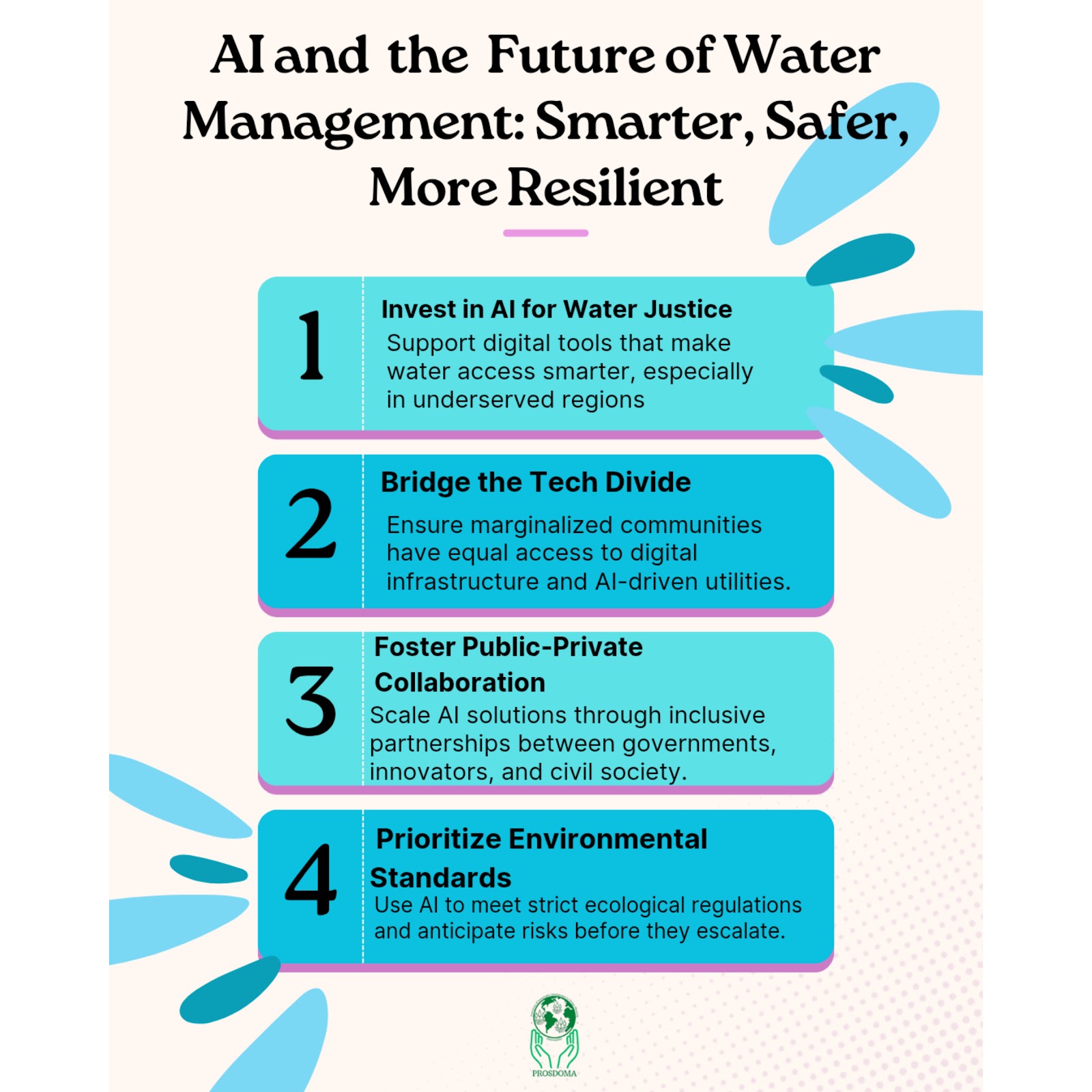
✅ What Can Be Done?
1️⃣ Invest in AI for Water Justice
Support digital tools that make water access smarter, especially in underserved regions.
2️⃣ Bridge the Tech Divide
Ensure marginalized communities have equal access to digital infrastructure and AI-driven utilities.
3️⃣ Foster Public-Private Collaboration
Scale AI solutions through inclusive partnerships between governments, innovators, and civil society.
4️⃣ Prioritize Environmental Standards
Use AI to meet strict ecological regulations and anticipate risks before they escalate.
Let’s build climate resilience through smart water systems. Learn more: www.prosdoma.org
by. E.D.
Source: World Economic Forum (2024), Xylem & Idrica – Water Technology Trends 2025
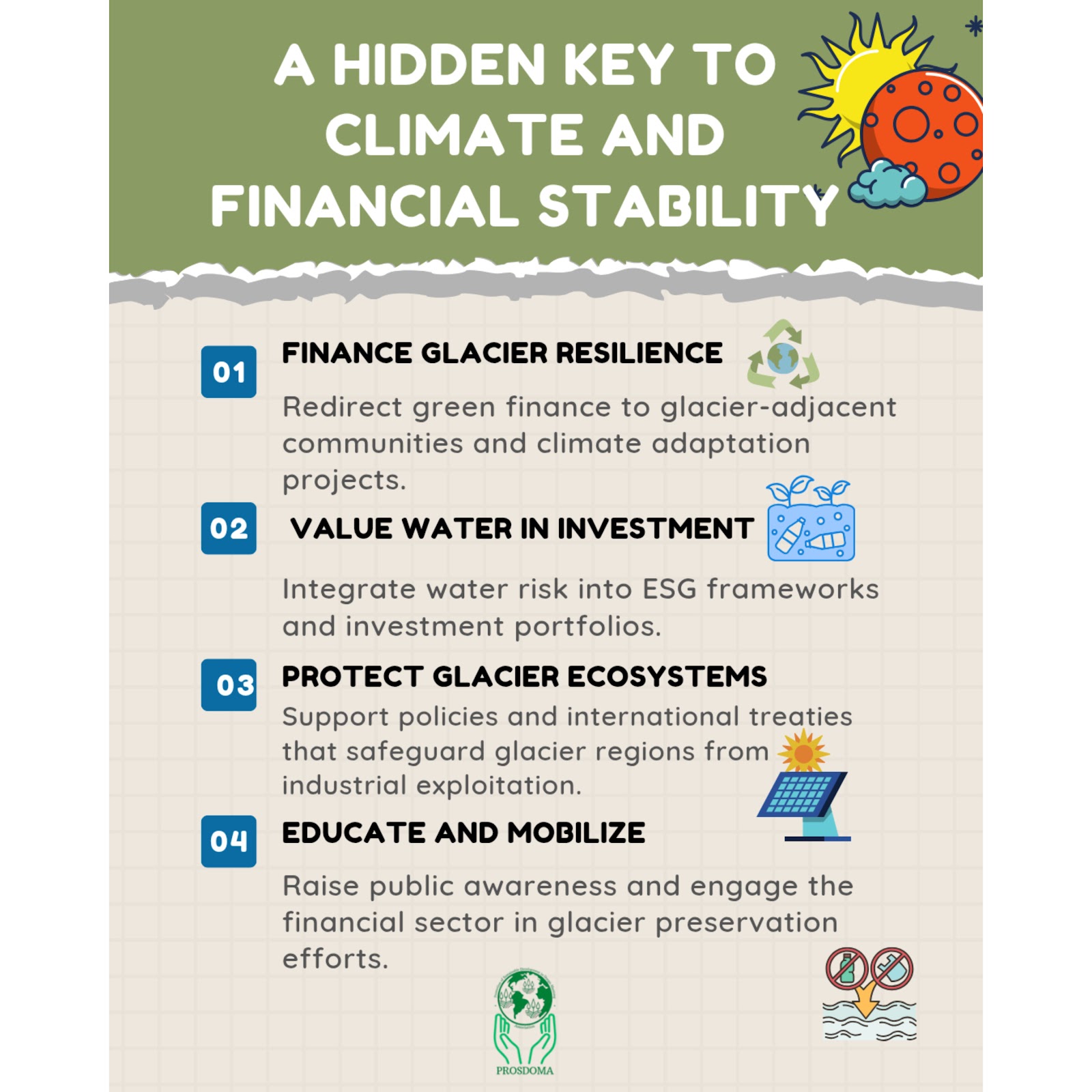
Glacier Preservation: A Hidden Key to Climate and Financial Stability
As climate change accelerates, glaciers, nature’s ancient water towers are disappearing at alarming rates. But what many overlook is that glacier loss is not just an environmental issue; it’s a financial risk.
According to the United Nations Environment Programme, the melting of glaciers threatens global water security, disrupts agriculture, and impacts over 1.9 billion people dependent on glacier-fed rivers. These risks ripple across economies, financial markets, and food systems.
In fact, climate-exposed sectors like insurance, agriculture, and energy face rising costs due to unreliable water flows and ecosystem collapse.
At PROSDOMA, we recognize that protecting glaciers isn’t just about conserving beauty, it’s about preserving livelihoods, food systems, and economic stability.
✅ What Can Be Done?
1️⃣ Finance Glacier Resilience
Redirect green finance to glacier-adjacent communities and climate adaptation projects.
2️⃣ Value Water in Investment
Integrate water risk into ESG frameworks and investment portfolios.
3️⃣ Protect Glacier Ecosystems
Support policies and international treaties that safeguard glacier regions from industrial exploitation.
4️⃣ Educate and Mobilize
Raise public awareness and engage the financial sector in glacier preservation efforts.
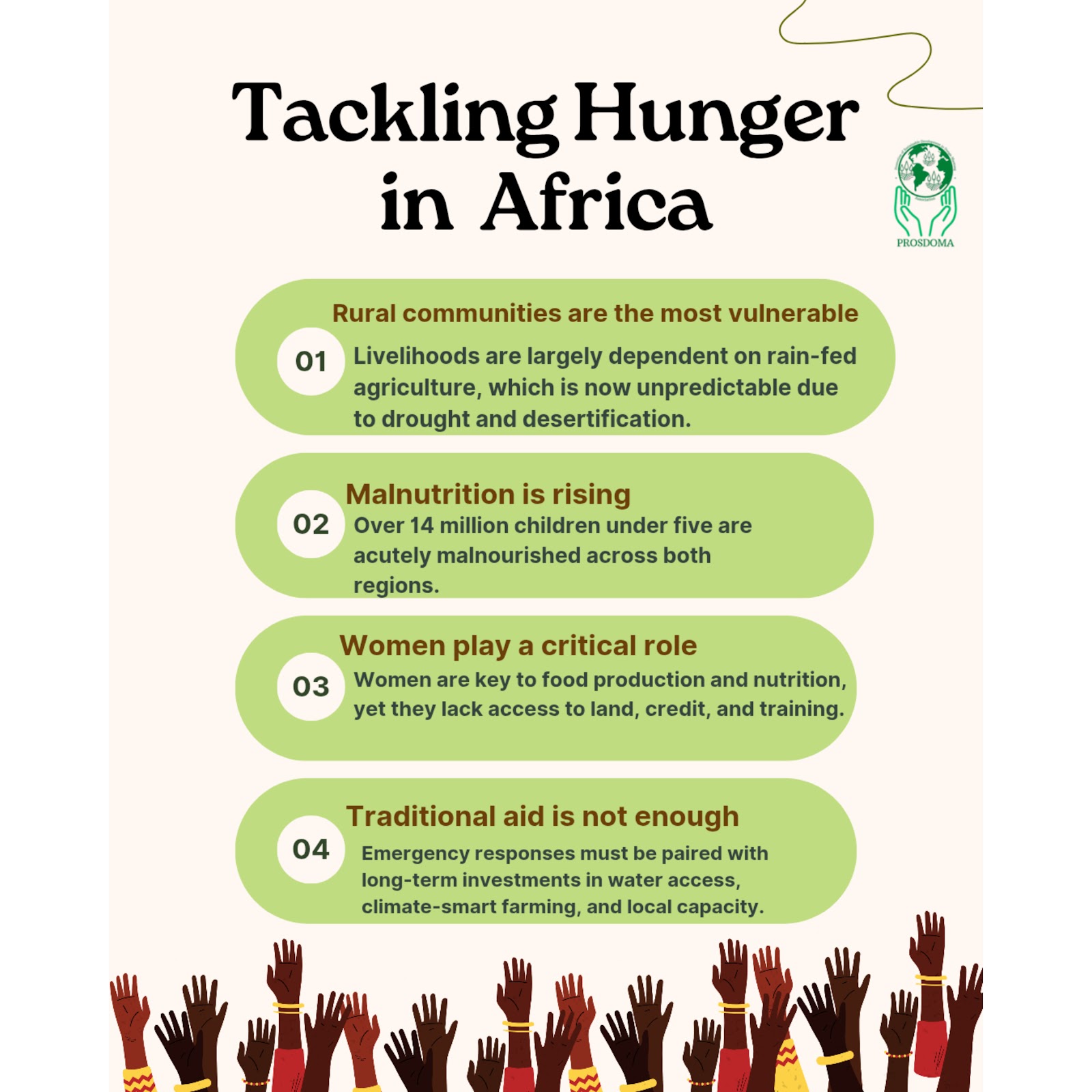
️ Resilience Starts with Food: Tackling Hunger in the Sahel & Horn of Africa
Climate shocks, conflict, and economic fragility have made the Sahel and Horn of Africa some of the most food-insecure regions in the world. Today, over 60 million people face hunger, malnutrition, and water stress, many of them women and children.
According to the FAO (2023), the key to long-term food and nutrition security lies in climate-resilient agriculture, community ownership, and integrated humanitarian-development approaches.
4 urgent realities:
1⃣ Rural communities are the most vulnerable.
Livelihoods are largely dependent on rain-fed agriculture, which is now unpredictable due to drought and desertification.
2⃣ Malnutrition is rising.
Over 14 million children under five are acutely malnourished across both regions.
3⃣ Women play a critical role.
Women are key to food production and nutrition, yet they lack access to land, credit, and training.
4⃣ Traditional aid is not enough.
Emergency responses must be paired with long-term investments in water access, climate-smart farming, and local capacity.
What can we do?
✅ Support agroecological and nutrition-sensitive agriculture
✅ Empower women and youth with resources and training
✅ Invest in early warning systems and local food systems
✅ Foster community-led adaptation strategies
At PROSDOMA, we stand with local changemakers building food resilience from the ground up. Food justice is climate justice.
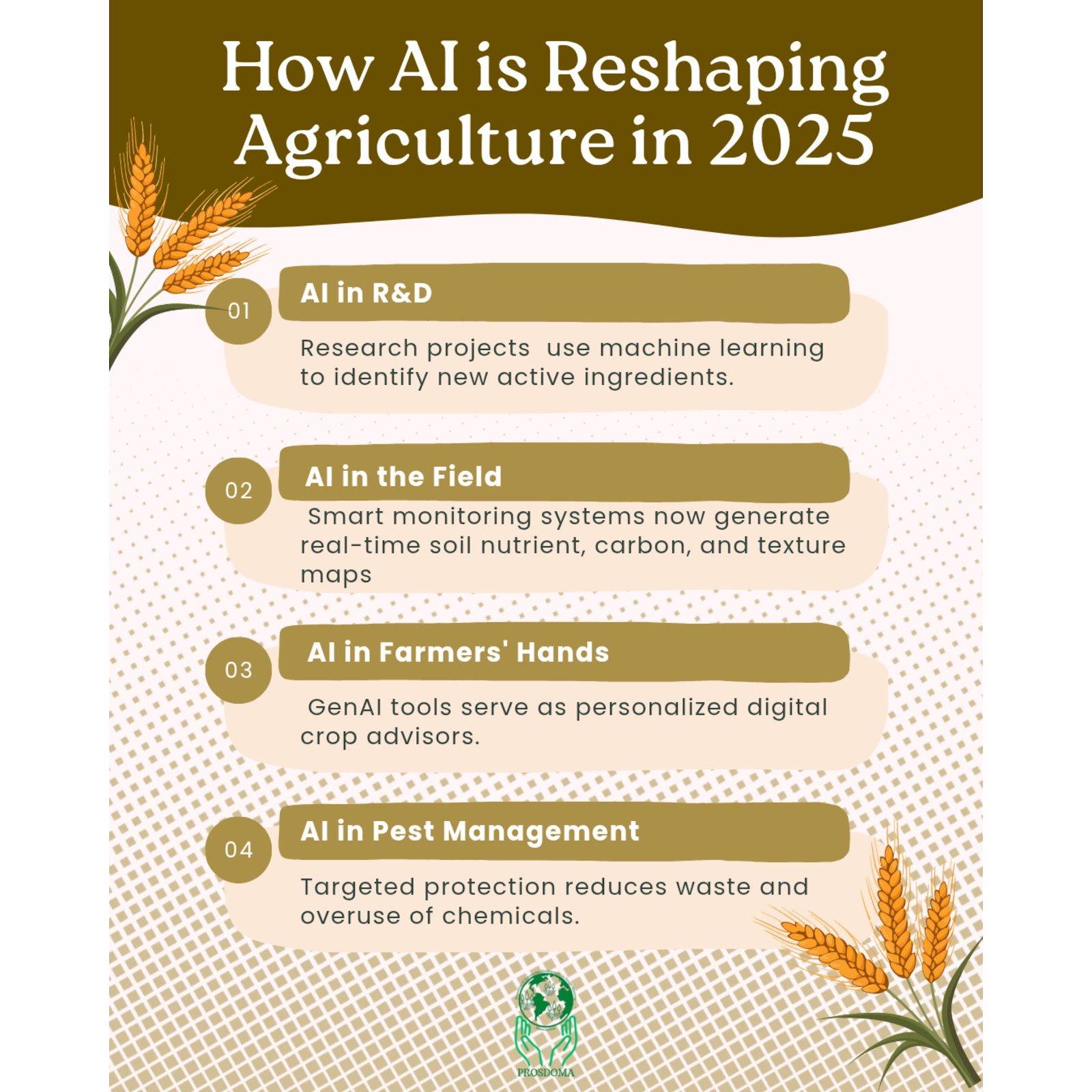
From Soil to Silicon: How AI is Reshaping Agriculture in 2025
At the 2025 World Economic Forum in Basel, Syngenta Group’s CEO Jeff Rowe declared it loud and clear: 2025 is the year AI will transform agriculture from the lab to the field.
Five key AI trends are defining this transformation:
1️⃣ AI in R&D :
Research projects use machine learning to identify new active ingredients.
2️⃣ AI in the Field:
Smart monitoring systems now generate real-time soil nutrient, carbon, and texture maps.
3️⃣ AI in Farmers’ Hands:
GenAI tools serve as personalized digital crop advisors.
4️⃣ AI in Pest Management:
Targeted protection reduces waste and overuse of chemicals.
The AgriTech market is expected to reach $54.17 billion by 2029, and AI in agriculture alone is projected to grow from $1.7B to $4.7B by 2028. According to the WEF, digital agriculture could boost the GDP of low- and middle-income countries by $450B annually.
But here’s the catch: technology must be accessible. At PROSDOMA, we believe the digital farming revolution must include smallholders, women, and rural communities, not leave them behind.
It’s not just about smart farms. It’s about fair farms.
Join us to cultivate an inclusive, tech-driven food future: www.prosdoma.org
By E.D.
Source:
Syngenta Group (2025). From Soil to Silicon: How Advanced Technologies are Cultivating the Future of Sustainable Ag. [Press Release via WEF & Bloomberg]
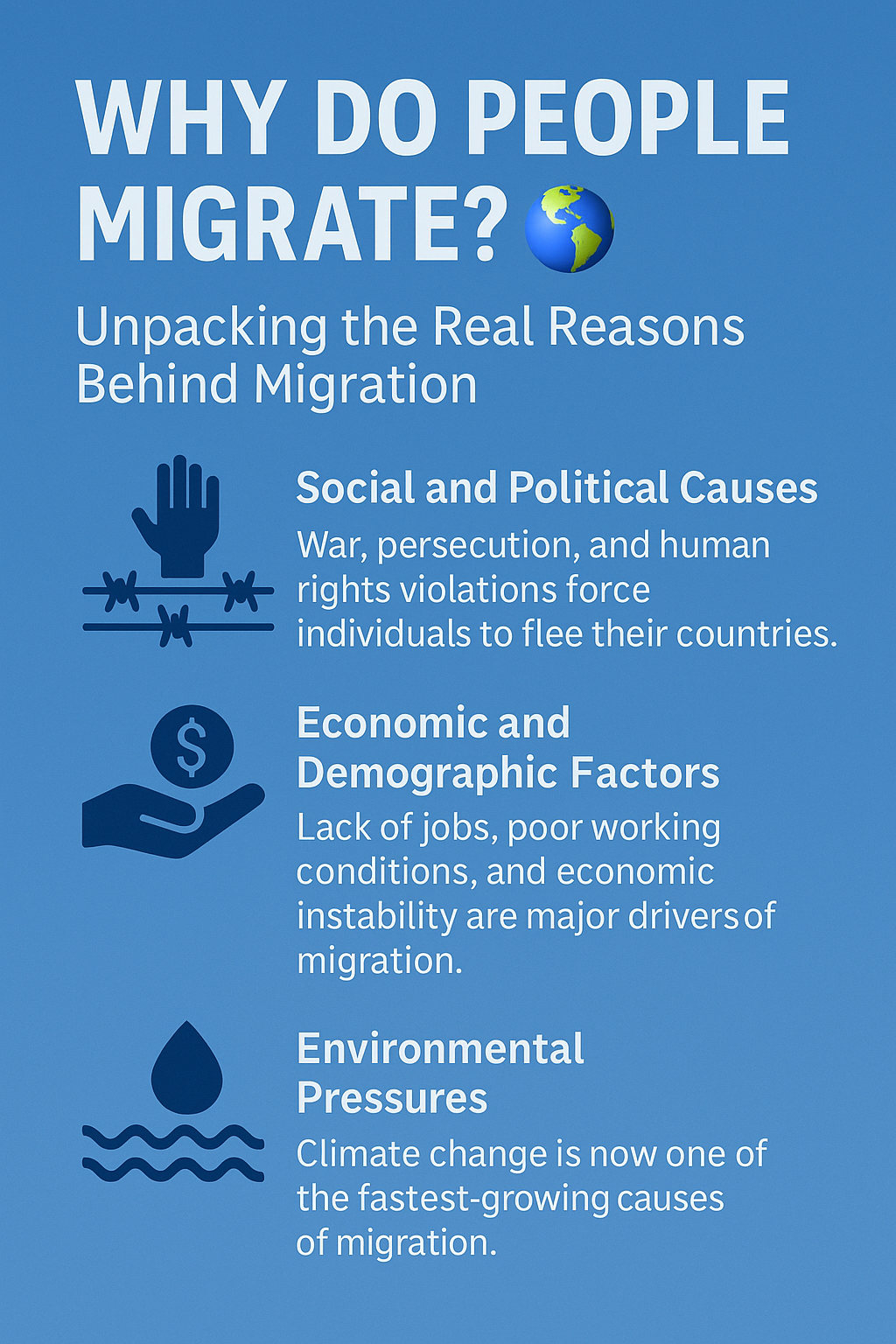
Migration isn’t just about crossing borders — it’s about people seeking safety, dignity, and opportunity.
Around the world, people leave their homes due to a mix of push and pull factors:
Social and Political Causes War, persecution, and human rights violations force individuals to flee their countries. In 2022, over 384,000 asylum seekers were granted protection in the EU — many from Syria, Afghanistan, and Venezuela.
Economic and Demographic Factors Lack of jobs, poor working conditions, and economic instability are major drivers of migration. In contrast, higher wages, better living standards, and education attract migrants to more stable nations.
Environmental Pressures Climate change is now one of the fastest-growing causes of migration. Floods, droughts, and natural disasters displace millions — and estimates suggest that by 2050, up to 1 billion people could become environmental migrants.
At PROSDOMA, we know that migration is not a choice for many — it’s a necessity. That’s why we work every day to support newcomers in Alberta by providing legal aid, job search assistance, computer training, and more.
We also raise awareness about the deeper causes of migration and advocate for policies that are fair, sustainable, and compassionate.
Let’s build a community where no one is left behind — whether they come from conflict zones, climate-affected regions, or economic hardship.
Join PROSDOMA in supporting migrants, raising awareness, and creating lasting change.


 Navigate job searches
 As Ruth Demeke, a newcomer turned community leader, shares: “Settlement agencies were vital to my success.” She now delivers info sessions at the same places that helped her family 30 years ago!
 Whether you’re new to Alberta or arriving from halfway across the world, these agencies are your lifeline to smoother integration, better opportunities, and a real sense of belonging.
 Don’t navigate your new life alone. Reach out to your local settlement agency—or connect with PROSDOMA today and let’s build your future together.
 Source: https://www.wes.org/how-settlement-agencies-in-canada-can-benefit-newcomers/
 Empowerment, not charity
 Wraparound care works
 Preserve dignity through innovation
 Women at the table

 Want to support newcomer integration in Alberta or Cameroon? Get involved with PROSDOMA today!
 Support sustainable food systems
 Learn more & get involved: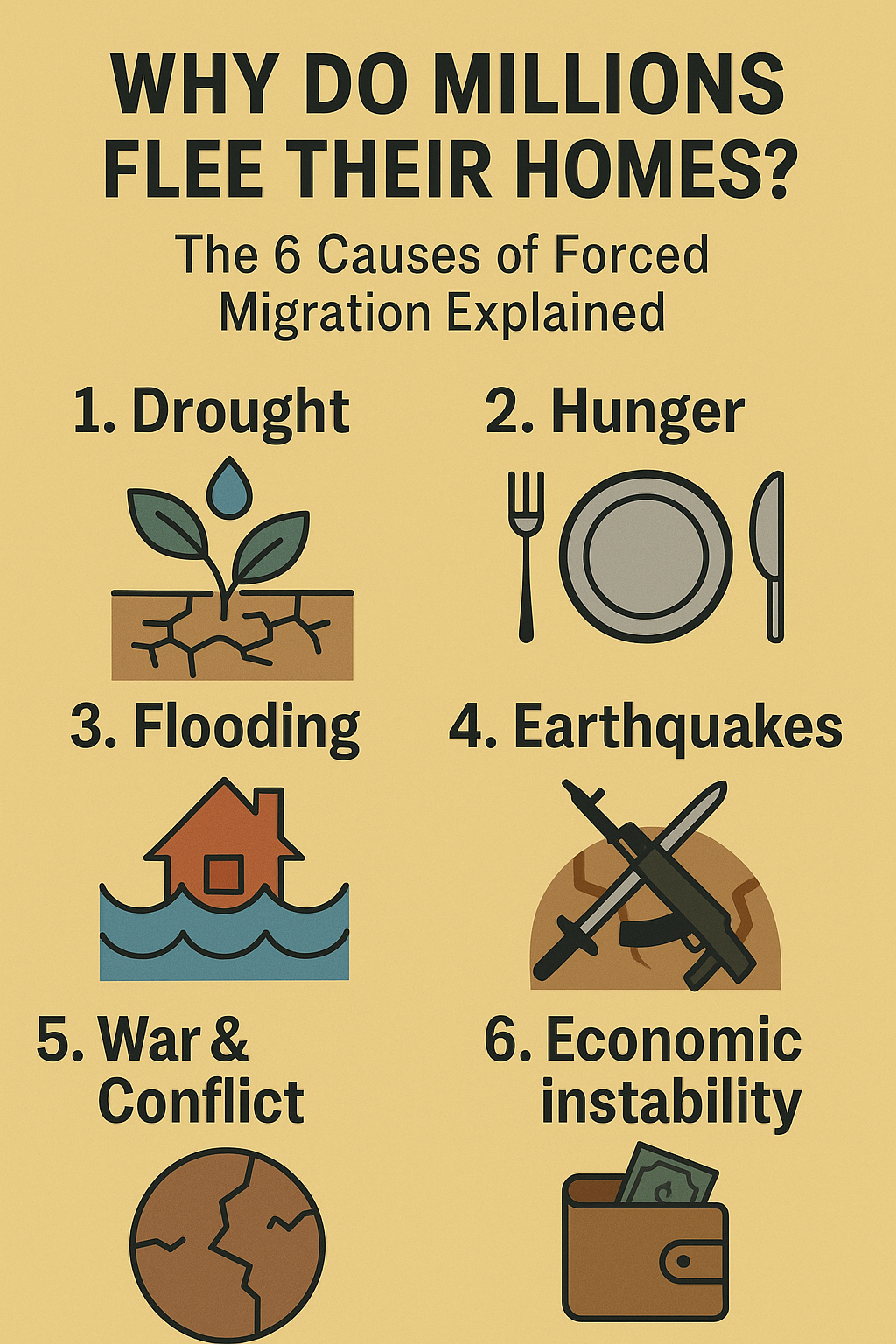

 1. Drought – Prolonged dry seasons destroy crops and leave communities without water, food, or income.
 2. Hunger – When harvests fail or food supplies are cut off due to conflict, families must migrate in search of survival.
 3. Flooding – Devastating floods can wipe out entire villages and force residents to flee for safety, often with no belongings left.
 4. Earthquakes – Sudden natural disasters, like the 2010 earthquake in Haiti or the 2015 Nepal quake, leave millions homeless.
 5. War & Conflict – The leading cause of forced migration. From Syria to South Sudan, violence drives families into exile.
 6. Economic instability – In places with high unemployment and rapid population growth, people migrate in search of opportunities to support their families.
 Share this post to spread awareness
 Connect with PROSDOMA to get involved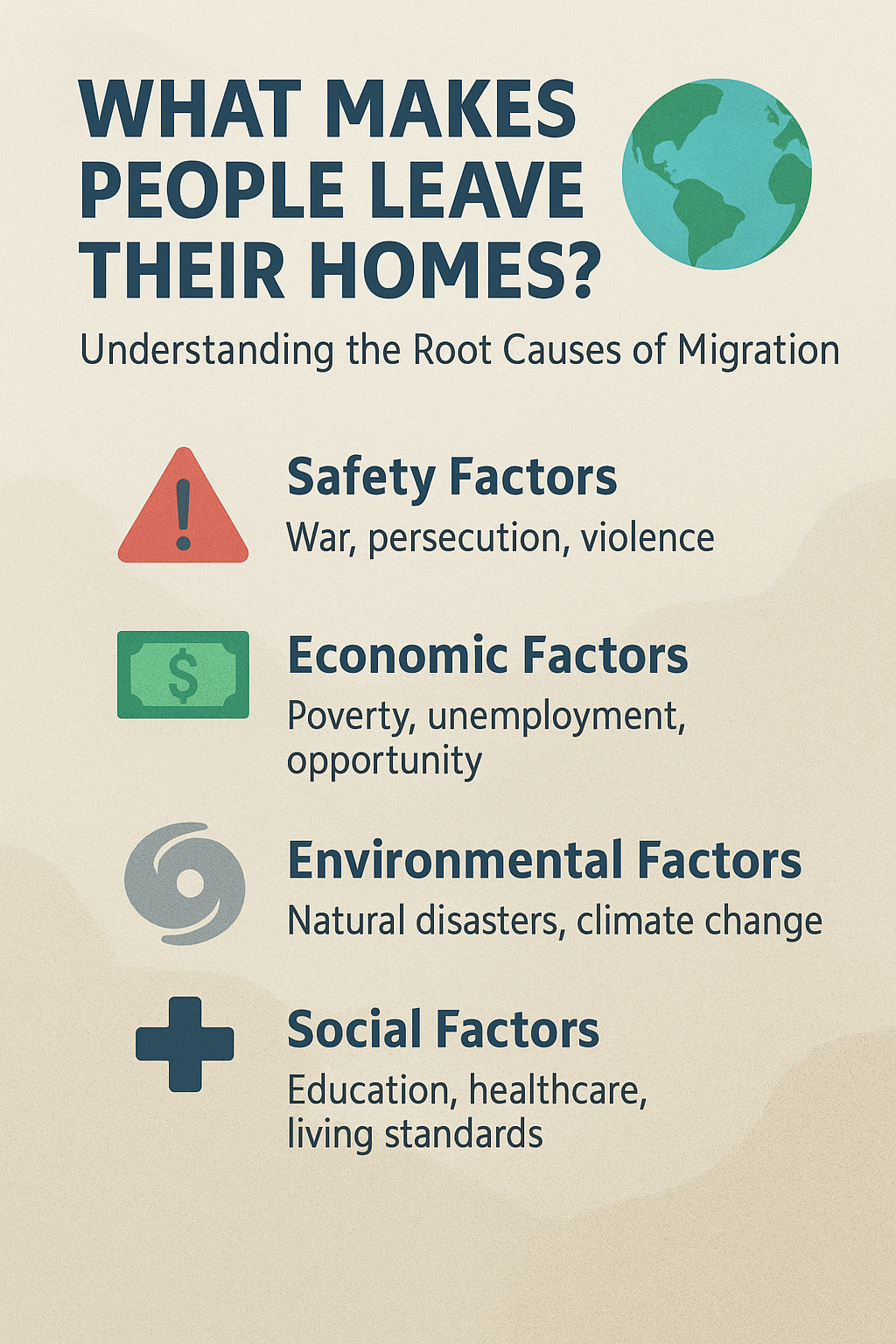
 Safety Factors: Many flee their homes due to war, persecution, or organized violence. In regions like the Northern Triangle (Guatemala, Honduras, El Salvador), gang violence and lawlessness force families to seek safer ground.
 Economic Factors: Poverty, unemployment, and lack of opportunity drive people to migrate to areas with higher wages and job availability. As economies improve or decline, so do migration patterns — as seen in Mexican migration trends to the U.S.
 Environmental Factors: Natural disasters, pollution, and climate change displace millions. From Haiti’s devastating earthquake to prolonged droughts in Syria, environmental crises fuel migration, often leaving communities vulnerable and unsupported.
 Social Factors: Education, healthcare, and better living standards motivate people to move. Migrants want to build a better life for their children, access life-saving treatment, or pursue career growth.

 .png> Rising temperatures
 .png> Extreme weather events like hurricanes, droughts, and floods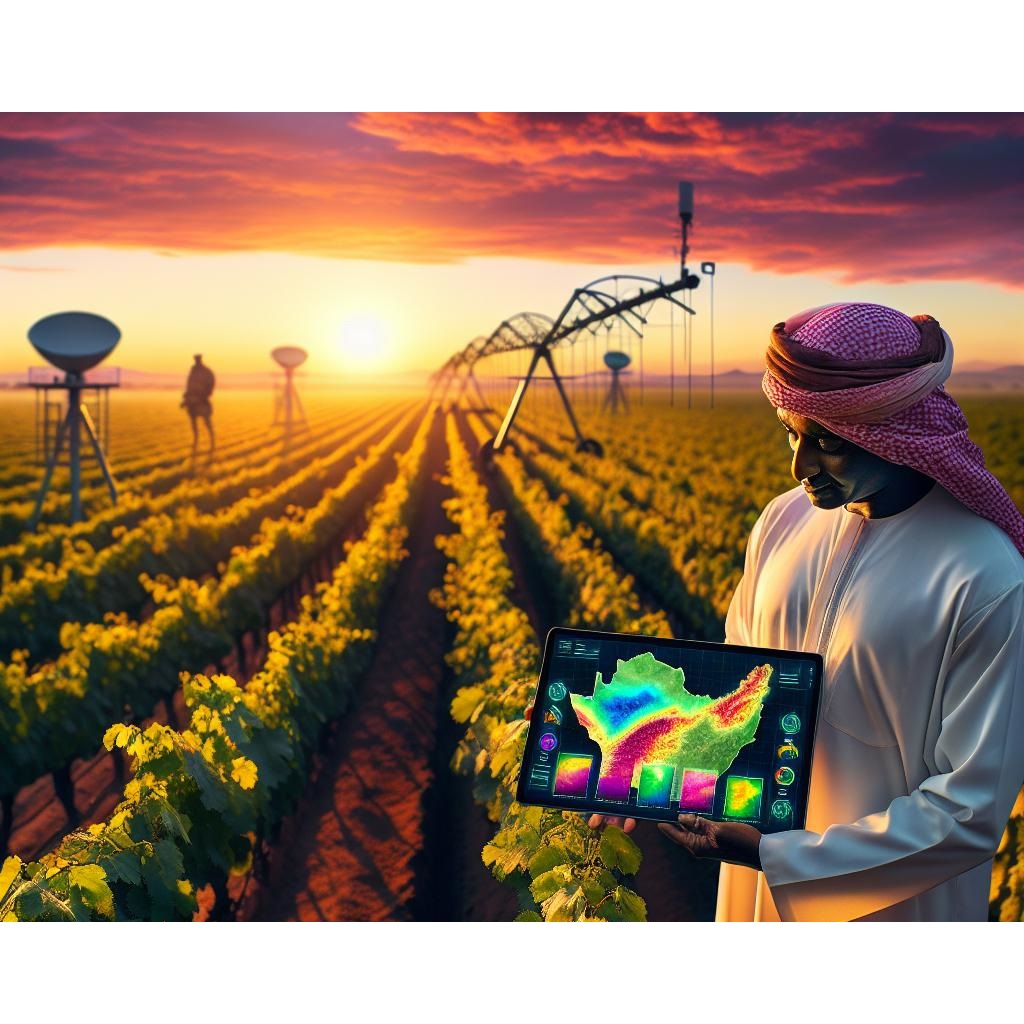
 Join PROSDOMA in supporting migrants, raising awareness, and creating lasting change.